Identity
Technical notes (click to open)(click to close)
Name & Human History
Etymology
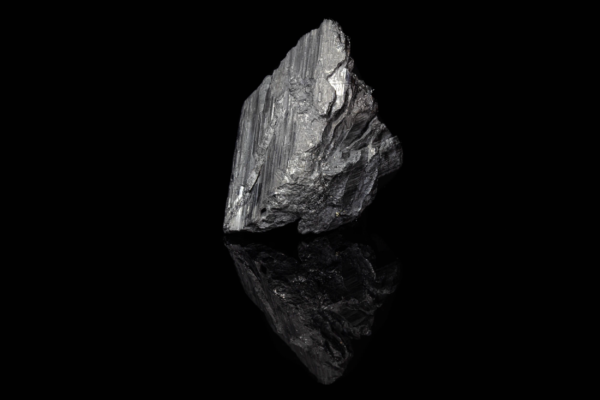
Andorite is a rare, dark gray mineral that most people will never see. It is a sulfosalt, a mineral built from metals like lead, silver, and antimony joined with sulfur. It was first described in 1892 from a mine in Romania. The name honors Andor von Semsey, a wealthy Hungarian nobleman who collected minerals and paid for the research that named it. He never found a mineral himself. He simply loved the science enough to fund it.
Today
Andorite has little use beyond the collector's cabinet. It carries silver, so it counts as a minor silver ore, mostly in the mines of Bolivia. But it is too scarce to matter much for mining. What draws collectors is its dark steel gray shine, often with a faint rainbow tarnish, and the simple fact that it is hard to find.
Geology & Occurrence
Formation
Andorite forms deep underground, in hot mineral veins where many metals travel together in the same fluids. As that fluid cools, the metals combine into a whole family of rare sulfosalts, and andorite is one of them. It grows as small, squat crystals with fine grooves down their length, usually tucked among other ore minerals.
Notable Localities
The best andorite comes from a few scattered places. The original find was at Baia Sprie in Romania. Fine crystals also come from Bolivia, where they grow alongside silver ores in the high Andes. Beyond a handful of such spots, the mineral is genuinely rare.
Andor von Semsey was the kind of patron science used to depend on. A rich Hungarian collector, he poured his fortune into mineralogy and let experts study his specimens. Two minerals carry his name, andorite for his first name and semseyite for his last. It was a way of thanking a man who helped the science without ever holding a title in it.
There is a twist hidden in the name. Modern study showed that what people called andorite is really two nearly identical minerals mixed together, telling apart only under a microscope. In 2022 they were given their own names, quatrandorite and senandorite. Collectors still use the old label andorite, because in the hand you simply cannot tell which one you are holding.