Identity
Technical notes (click to open)(click to close)
Name & Human History
Etymology
Apophyllite has one of the most fitting names in the mineral world. It comes from two Greek words meaning away from and leaf. Heat a piece and it does something strange. It peels and flakes apart, leaf by leaf, as the water trapped inside escapes. The French scientist Rene Just Hauy noticed this and named the mineral for it in 1806.
Today
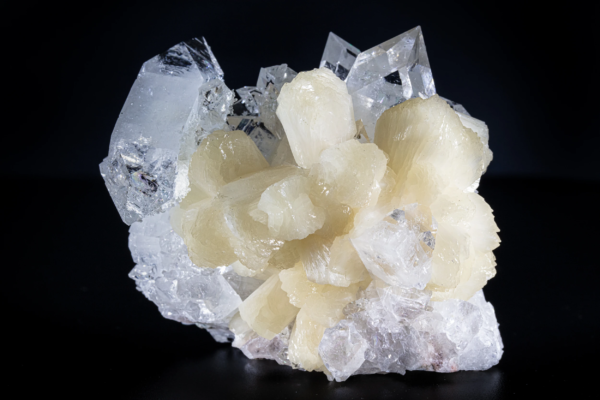
Apophyllite is no longer a single mineral but a small group of close cousins, sorted by tiny differences in their makeup. The one most people mean by the name is common and widespread. It is loved by collectors for its glassy, often colorless crystals, which can be pale green, pink, or yellow, and which catch the light with a bright, watery shine.
Geology & Occurrence
Formation
Apophyllite grows inside old lava. As gas bubbles cool in volcanic rock, they leave empty pockets, and mineral rich water slowly fills them. Apophyllite crystallizes in these pockets, often beside zeolites, another family of minerals born the same way. The two are frequent partners, and a single rock can hold a whole garden of them.
Notable Localities
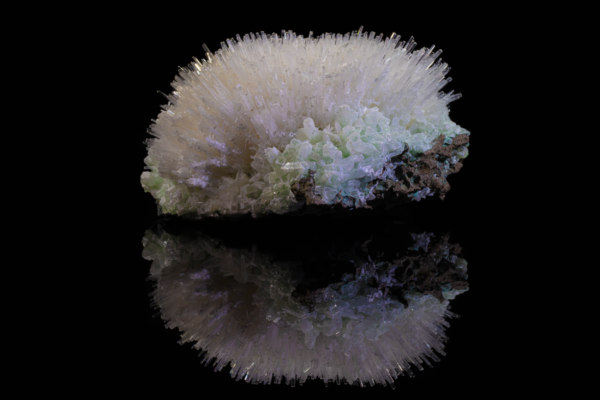
By far the most famous apophyllite comes from India. The huge basalt quarries near Pune and Nashik have produced crystals in staggering numbers and sizes. The rare green ones, found there with sparkling white zeolites, are among the most prized of all. Good apophyllite also turns up in Brazil, Germany, and many other lands of old lava.
The name is also a handy field test. Hold a flame to apophyllite and it will swell, crack, and shed flakes as its water boils away. Few minerals behave so plainly. That habit, written right into the Greek name, is what set apophyllite apart for scientists two hundred years ago, long before anyone could study its inner structure.
A fine Indian apophyllite is a small landscape in itself. Clear, glassy crystals sit among white sprays of zeolite, sometimes tinted a soft sea green. These pieces line the gas pockets of ancient lava flows that erupted across India many millions of years ago. Collectors prize them for the way light seems to swim inside the crystals.