Identity
Technical notes (click to open)(click to close)
Name & Human History
Etymology
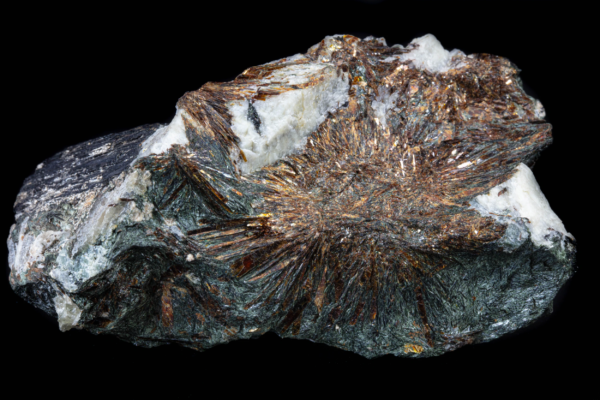
Astrophyllite has a name as striking as its looks. It comes from two Greek words meaning star and leaf. The mineral grows as thin golden blades that fan out from a center, like the rays of a star or the spokes of a wheel. Set against dark rock, these bronze sprays catch the light and seem to glow. A scientist named it for that starry, leafy habit in 1854.
Today
Astrophyllite is rare, and it lives mostly in the collector's cabinet. Its golden blades are too soft and brittle for jewelry, so specimens are usually left in the rock that holds them. Collectors often have a piece sliced flat and polished, turning the dark stone into a window full of golden stars. The contrast between the bright metal sheen and the plain matrix is the whole appeal.
Geology & Occurrence
Formation
Astrophyllite forms in unusual rocks. It belongs to a rare family of stones rich in elements like titanium and rare metals, the kind that gather only in the last, strange dregs of a cooling magma. It grows in coarse veins and pockets within these special rocks, often beside equally rare minerals. That is why it shows up in only a handful of places on Earth.
Notable Localities
The first astrophyllite was found on a small island in Norway, which remains its classic home. Some of the finest pieces today come from the Kola Peninsula in Russia, from Greenland, and from a famous quarry at Mont Saint-Hilaire in Canada. In the United States, golden astrophyllite turns up near Pikes Peak in Colorado. None of these sources is common.
At a glance, astrophyllite looks much like brown mica. Both grow as shiny, layered, golden brown sheets, and the two fooled early scientists for years. The difference is in the touch. Mica peels into thin, bendy flakes that spring back. Astrophyllite is brittle. Its blades snap rather than bend, a simple test that tells the star mineral from its softer look alike.