Identity
Technical notes (click to open)(click to close)
Name & Human History
Etymology
Azurite is named for its color, a deep and unmistakable blue. The word traces back through old languages to a Persian term for blue, the same root that gives us the word azure and the name of lapis lazuli. People knew the stone for thousands of years before it got this name. A French mineralogist, Francois Sulpice Beudant, settled on azurite in 1824. An older name, chessylite, came from Chessy near Lyon in France, once a celebrated source.
Through the Ages
For centuries, azurite was the great blue of European painting. Ground into a powder, it gave artists a rich blue that was far cheaper than the blue made from imported lapis lazuli. Painters used it for skies, robes, and water from the Middle Ages through the Renaissance. There is a catch, though. Over long periods, azurite can slowly change into green malachite, a close cousin. That is why some old paintings now show green leaves or skies that the artist first painted blue.
Today
Azurite is no longer used as a paint, since modern blues are cheaper and last longer. Now it is valued mostly by collectors, who prize its electric blue crystals and the way it grows side by side with green malachite. It also serves a practical purpose in the field. Because azurite forms only where copper is present, prospectors treat a flash of its blue as a reliable sign that copper ore lies nearby.
Geology & Occurrence
Formation
Azurite is a copper mineral, and it forms near the surface where buried copper ore meets air and water. As that copper slowly weathers, it dissolves and joins with other elements to make new minerals, and azurite is one of them. It almost always keeps company with malachite, its green relative, and the two can blend in a single piece. Given enough time and moisture, blue azurite will quietly turn into green malachite, which is why fresh, deep blue crystals are the more prized of the two.
Notable Localities
The mines of Bisbee, Arizona, produced some of the deepest blue crystals ever found. Tsumeb in Namibia is another legendary source, famous for sharp, glassy crystals. Morocco supplies bright blue specimens to collectors today. The original French source at Chessy is long exhausted, but its old specimens, labeled chessylite, are still treasured.
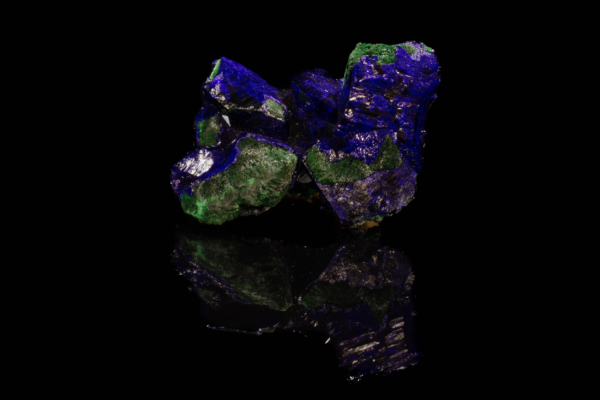
Azurite and malachite are two faces of the same chemistry, both built from copper, and azurite is slowly turning into malachite all the time. Collectors sometimes find crystals caught halfway through the change, blue at the core and green at the edges. In some pieces the blue azurite is gone completely, replaced atom by atom with green malachite that kept the exact shape of the crystal it grew over.
The blue was known and used long before it had its modern name. The Roman writer Pliny the Elder described it nearly two thousand years ago under the Greek word kuanos, the same root behind the color word cyan. Egyptians ground it for pigment even earlier. The stone that Beudant finally named azurite in 1824 had already been coloring art for thousands of years.