Identity
Technical notes (click to open)(click to close)
Name & Human History
Etymology
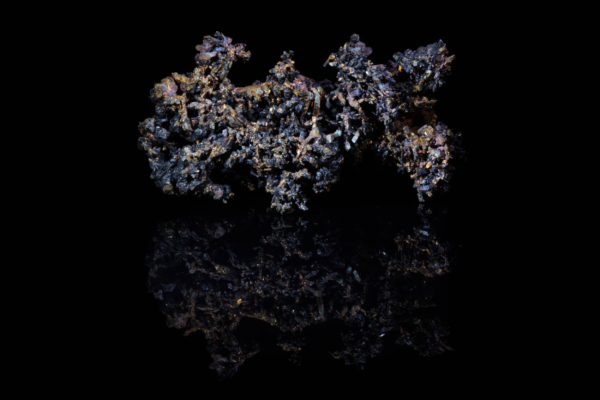
Cuprite is one of the most beautiful red minerals in the world, and a valuable copper ore besides. Its name comes straight from cuprum, the Latin word for copper, because it is so rich in that metal. It is a copper oxide, and the finest crystals glow a deep, fiery red, like garnet or ruby. This has earned it the fond old nickname ruby copper.
Today
Cuprite is both useful and lovely. With a high copper content, it serves as an ore of the metal wherever it gathers in quantity. But its real fame is among collectors. Clear, deep red cuprite crystals are sometimes cut into gems, though they are very soft and best kept in a case. A fine red cuprite is one of the great treasures of any mineral collection.
Geology & Occurrence
Formation
Cuprite forms near the surface, in the weathered upper zone of copper deposits. As copper minerals break down in air and water, cuprite can crystallize as sharp red cubes and eight sided forms. It is often found alongside native copper, green malachite, and blue azurite. A rare, hair like variety, made of fine red needles, is called chalcotrichite.
Notable Localities
Some of the world's finest cuprite comes from Africa. The Onganja mine in Namibia produced legendary large, gemmy red crystals, and nearby Tsumeb is another great source. Fine cuprite also comes from the copper mines of Arizona, from Cornwall in England, and from the copper belt of the Congo.
The deep red of a fine cuprite hides a quiet drama. The crystals are so soft and easily scratched that cutting one into a gem is a real feat, and the results are too fragile to wear. Yet a clear cuprite throws back a red so rich and bright that it rivals far harder gems. Collectors treasure these red crystals as some of the most striking the mineral world has to offer.