Identity
Technical notes (click to open)(click to close)
Name & Human History
Etymology
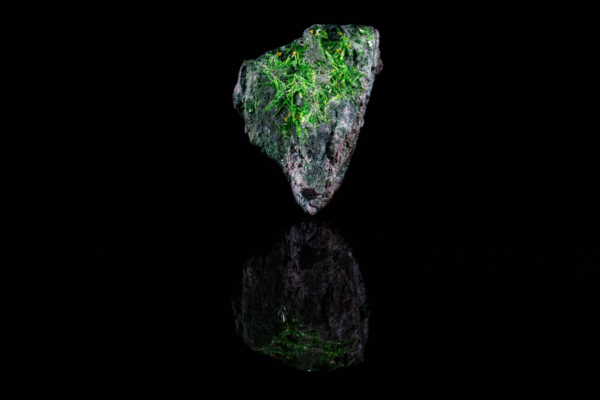
Cuprosklodowskite is a vivid green mineral with a famous name and a powerful nature. It is radioactive. The mineral is a copper uranium silicate. The uranium inside it makes it glow green and gives off radiation. Its long name honors one of science's greatest figures. It means the copper version of sklodowskite, a mineral named for Marie Sklodowska-Curie, the pioneer of radioactivity.
Today
This is strictly a specialist's mineral, valued by collectors of uranium minerals and treated with great care. Because it is radioactive, it is kept in a sealed case, well away from where people live and sleep. Collectors never grind it, breathe its dust, or handle it without washing afterward. Its bright grassy green needles, though, make it a striking and sought after rarity.
Geology & Occurrence
Formation
The mineral forms near the surface, where uranium ore breaks down in the presence of copper. As the primary uranium minerals weather, their uranium recombines with copper and silica into this green crystal. It grows as fine needle like crystals and tufts. It often coats other uranium minerals in a bright green crust.
Notable Localities
The classic specimens come from the famous uranium deposits of Katanga, in the Congo. There the mineral grows alongside a whole suite of colorful uranium minerals. Smaller finds come from a scattering of other uranium districts around the world. Fine green specimens remain scarce.
The name of this mineral is a tribute to a remarkable scientist. Marie Curie, born Maria Sklodowska in Poland, discovered the elements radium and polonium and won two Nobel Prizes. A uranium mineral was named sklodowskite in her honor. When the copper bearing version was found, it took the longer name. So this little green crystal carries the memory of the woman who first taught the world about radioactivity.