Identity
Technical notes (click to open)(click to close)
Name & Human History
Etymology
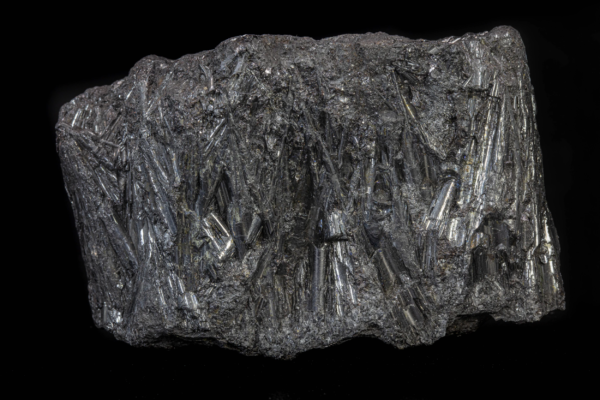
Cylindrite may have the strangest shape of any mineral on Earth. Almost every mineral grows as flat faced crystals joined at sharp angles. Cylindrite breaks that rule completely. It grows as smooth, rounded cylinders, like tiny rolls or tubes of dark metal. Its name comes from the Greek word for cylinder, and it is the only mineral known to form true cylindrical crystals.
Today
Cylindrite is a heavy, dark gray metallic mineral, built from lead, tin, iron, and antimony with sulfur. It is too rare to be a useful ore, so it lives entirely in the world of collectors. For those who love the unusual, a spray of its rolled, tube like crystals is a true prize, unlike anything else in the mineral kingdom.
Geology & Occurrence
Formation
The secret to its odd shape lies deep in its structure. Cylindrite is built from two kinds of atomic sheets stacked one on another. The two sheets do not quite match in size, so as they pile up, the whole stack curls, like a sandwich of two materials that bends in the heat. This curling rolls the crystal into its signature tube. Press on one and it unrolls into curved leaves.
Notable Localities
Cylindrite comes almost entirely from Bolivia, from the tin mining country high in the Andes. The Santa Cruz mine near Poopo, where it was first found in the 1890s, is its classic home. It grows there in the same rich veins that hold tin and silver ores. A few other Bolivian mines produce it, but fine cylindrite is scarce everywhere.
Cylindrite shows how the hidden arrangement of atoms can shape what we see. Its rolled tubes are not a trick of weathering or a chance of growth, but the direct result of two mismatched layers locked together deep inside. The same effect, on a far smaller scale, curls certain other minerals into microscopic tubes. In cylindrite alone, the rolling grows large enough to hold in your hand.