Identity
Technical notes (click to open)(click to close)
Name & Human History
Etymology
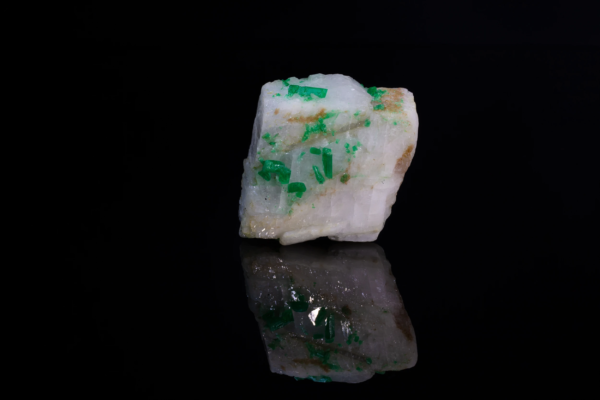
Emerald is the green gem variety of a mineral called beryl, and one of the most treasured stones on Earth. Pure beryl is colorless. A trace of chromium, and sometimes vanadium, is what turns it the deep, vivid green we call emerald. The name comes through old languages from a Greek word that simply meant green gem. For thousands of years, that green has stood for spring, renewal, and great wealth.
Through the Ages
Emerald has been prized since ancient times. The Egyptians mined it more than two thousand years ago, and one set of old workings is still known as Cleopatra's mines. Today emerald is judged above all by its color, a rich green that is neither too pale nor too dark. Most emeralds hold tiny cracks and inclusions, so many are gently treated with oil to improve their look.
Geology & Occurrence
Formation
Emerald forms in an unusual way, which is part of why it is so rare. Its key ingredients almost never meet in nature. The beryllium that builds beryl and the chromium that colors it green normally come from very different rocks. Only where unusual geology brings them together, as in altered limestone or certain schists, can emerald grow.
Notable Localities
The world's finest emeralds come from Colombia, where they grow in veins cutting through dark shale. The famous mines of Muzo and Chivor have produced superb crystals for centuries. Zambia is now a major source of fine emerald, and good stones also come from Brazil, Afghanistan, and Pakistan. Each region tends to give its emeralds a slightly different shade.
There is a real difference between an emerald and a plain green beryl, and it comes down to color. The very same mineral, beryl, can be a soft, pale green that is pretty but not precious. Only when the green is rich and deep does the stone earn the name emerald, and the leap in value is huge. Telling a fine emerald from a mere green beryl is one of the basic skills of the gem trade.