Identity
Technical notes (click to open)(click to close)
Name & Human History
Etymology
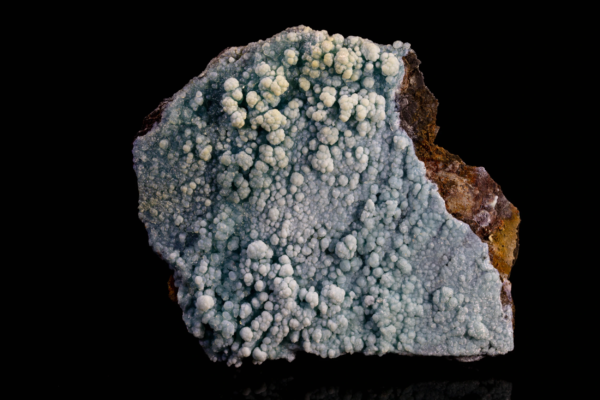
Gibbsite is a soft, pale mineral, a hydroxide of aluminum. It is usually white or gray, sometimes tinted green or pink, with a pearly to glassy shine. Sharp crystals are rare and tiny, so it is most often seen as rounded crusts, botryoidal knobs, and earthy masses. It was named in 1822 for George Gibbs, an American mineral collector, and first came from Richmond, Massachusetts.
Today
Gibbsite may look plain, but it is one of the most important minerals in the world. It is the main aluminum mineral in bauxite, the ore that gives us nearly all our aluminum, the light metal in cans, foil, cars, and aircraft. Collectors know a different side of it: rare crystals from China come in vivid green and blue, prized for their color.
Geology & Occurrence
Formation
Gibbsite forms at the surface, where aluminum rich rocks are broken down by weathering. In warm, wet climates, rain and time strip away other elements and leave aluminum behind, building thick deposits called bauxite. Gibbsite grows there as crusts and rounded masses. It also appears in altered clays, limestones, and low silica igneous rocks.
Notable Localities
As a bauxite mineral, gibbsite is common across the tropics, in great deposits in Jamaica, Guinea, and Australia. Fine crystals for collectors are far rarer and more scattered. Some of the best come from China, in bright green and blue, from Hunan and Yunnan. Its type locality is Richmond, Massachusetts, and good specimens also turn up in Norway.
The mineral honors George Gibbs, a wealthy American who built the finest mineral collection in the country in the early 1800s. He was not a miner but a merchant who loved the science. When his collection was sold, Yale University bought it, and those specimens became the heart of one of the great teaching collections in America. The stone keeps his name long after the collection changed hands.