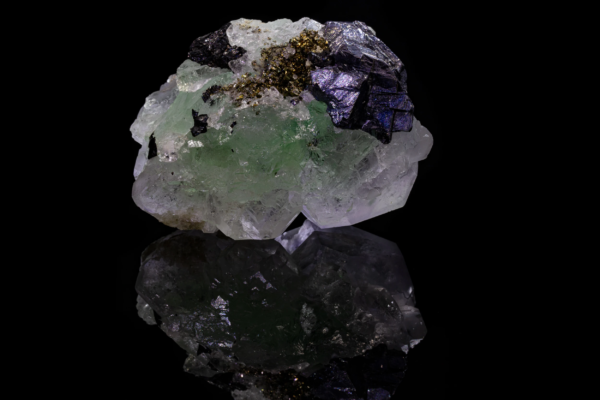
Identity
Technical notes (click to open)(click to close)
Name & Human History
Etymology
Gypsum takes its name from the Greek word gypsos, which simply meant plaster. The name says exactly what people have done with it for thousands of years. Gypsum is a soft mineral made of calcium, sulfur, and water. Heat it gently and it gives up that water as a fine powder. Add water back and the powder sets hard again. That simple trick is the heart of plaster, and it has shaped walls, statues, and ceilings since ancient times.
Through the Ages
For ages, gypsum was the mineral you reached for when you wanted a smooth white surface. The ancient Egyptians used it in their building plasters. A fine, even kind called alabaster was soft enough to carve, so it became a favorite for vases, statues, and church altars across the ancient and medieval world. The most famous plaster of all took its name from a single place. Paris sat on rich gypsum beds, and the white powder baked from them became known around the world as plaster of Paris.
Today
Gypsum is one of the quiet giants of modern building. Pressed between paper, it becomes the drywall that lines the rooms of most homes. It is also mixed into cement to control how fast it sets, spread on farm fields to loosen heavy soil, and used to make molds and casts, including the cast a doctor sets around a broken arm. Few minerals touch daily life in so many plain and useful ways.
Geology & Occurrence
Formation
Gypsum usually forms when salty water dries up. As a shallow sea or a desert lake slowly evaporates, the dissolved minerals drop out in layers, and gypsum is one of the first to settle. Over time this can build thick beds of rock hundreds of feet deep. Because it forms this way, gypsum often appears as pale, soft layers, but it can also grow as clear crystals, as silky fibers, or as sandy rosettes known as desert roses. Its softness is a giveaway, since you can scratch most gypsum with a fingernail.
Notable Localities
Gypsum is found on every continent and is the most common of all the sulfate minerals. Vast deposits are mined in the United States, Canada, Spain, and many other countries. One of the most striking places to see it is White Sands in New Mexico, where wind has piled pure white gypsum into a sea of dunes. Fine crystals and carving grade alabaster come from Italy, Spain, and beyond.
Plaster of Paris really did come from Paris. The hills of Montmartre and the ground beneath the city held large beds of gypsum, and for centuries that gypsum was dug, baked, and ground into a smooth white plaster. It was so widely traded that the city's name stuck to the product itself. Even today, far from France, a sculptor's mold or a doctor's cast may still be called plaster of Paris.
At White Sands in New Mexico lies a desert unlike any other, with dunes of brilliant white gypsum stretching to the horizon. Gypsum sand is rare, because the mineral usually dissolves in water and washes away to the sea. Here the land has no river to the ocean, so the gypsum stays, dries, and breaks into fine pale grains. The result is one of the largest fields of gypsum dunes on Earth, cool to the touch even under a hot sun.