Identity
Technical notes (click to open)(click to close)
Name & Human History
Etymology
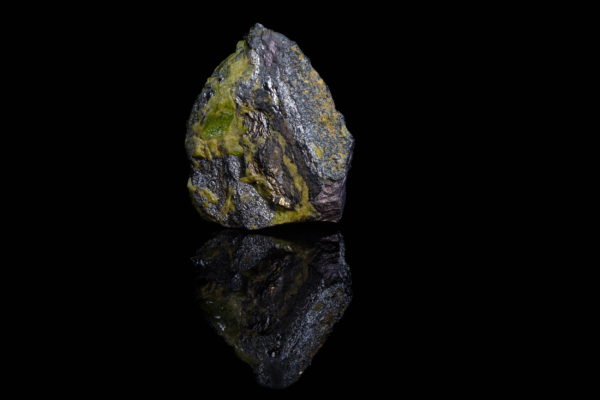
Ilmenite is a heavy black mineral, an oxide of iron and titanium. It has a metallic to nearly metallic shine and leaves a black to brownish red streak. Sharp crystals are rare; it is usually massive or in thick tabular grains, and it is weakly magnetic. It was named in 1827 for the Ilmen Mountains of the southern Ural region in Russia, where it was first described.
Today
Ilmenite is the world's most important source of titanium. Most of it is not turned into metal but into titanium dioxide, a brilliant white powder used as a pigment. For collectors it is a common accessory in many rocks, a heavy, lustrous black mineral found in thick tabular crystals or concentrated in dark beach sands.
Geology & Occurrence
Formation
Ilmenite forms early, deep in cooling magma, especially in dark iron rich rocks like gabbro and anorthosite. There it crystallizes before most other minerals and can settle into thick layers. Because it resists weathering, it also survives the breakdown of these rocks and gathers in rivers and along beaches as heavy black sand.
Notable Localities
Ilmenite is widespread. Its namesake crystals come from the Ilmen Mountains in Russia. Large masses are worked at places like Allard Lake in Quebec and in Norway. As a beach sand mineral it is mined on a huge scale in Australia, South Africa, and India, where whole shorelines carry dark titanium rich sand.
Titanium was first found hiding in this humble black mineral. In 1791 an English clergyman, William Gregor, sifted a dark sand from a Cornish stream and realized it held an unknown metal. The same mineral later turned up in Russia's Ilmen Mountains and took the name ilmenite. The metal it carried was long a curiosity with no use, until the twentieth century made it prized for aircraft and medical implants.