Identity
Technical notes (click to open)(click to close)
Name & Human History
Etymology
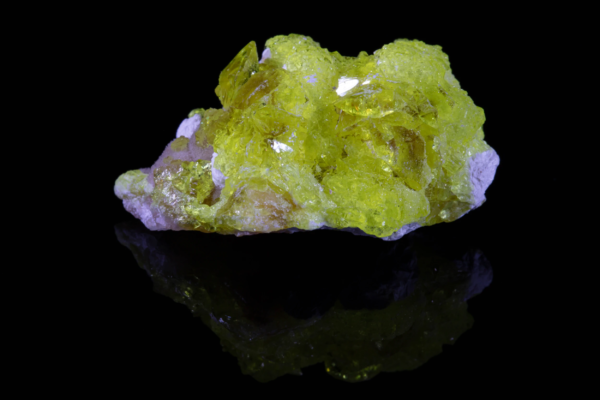
Jouravskite is one of the rarest minerals here, a hydrated sulfate and carbonate of calcium and manganese. It forms small greenish yellow to greenish orange crystals with a six-sided outline, usually as sugary crusts and blotches rather than sharp points. It was described in 1965 and named for Georges Jouravsky, chief geologist of Morocco.
Today
Jouravskite is a specialist's mineral. It is known from only a handful of places on Earth, so a specimen is a rarity rather than a display piece: the crystals are tiny and the color is a soft lemon to greenish yellow. It has no use beyond the collection, though its structure interests the chemists who study cement.
Geology & Occurrence
Formation
Jouravskite grows at the surface, in the weathered upper part of manganese deposits. There, manganese in an unusually oxidized state meets calcium, sulfate, and carbonate in cool water, and the mineral crystallizes with a great deal of water locked into its structure. The conditions have to be narrow, which is why it is found almost nowhere.
Notable Localities
Jouravskite was first found at Tachgagalt, an old manganese mine south of Ouarzazate in the Anti-Atlas mountains of Morocco. That remains its type locality. The other significant source is the N'Chwaning mine in the Kalahari manganese field of South Africa, which has produced its best crystals. Beyond these two, occurrences are almost nonexistent.
The mineral honors a man who never saw it named. Georges Jouravsky spent his career as chief geologist of the Geological Survey of Morocco, mapping the ore deposits of a country he made his life's work. He died in 1964. The mineral pulled from a Moroccan manganese mine was described and given his name the following year.