Identity
Technical notes (click to open)(click to close)
Name & Human History
Etymology
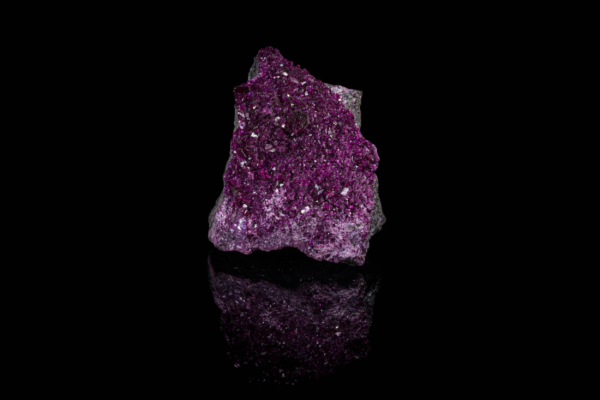
Kammererite is not a species of its own. It is clinochlore, a common green mineral of the chlorite group, that has taken up chromium, and the chromium changes everything: the green becomes an intense magenta, purple, or crimson. The crystals are thin plates with a six-sided outline and a pearly shine. The name dates to 1841 and honors Alexander Kammerer, a mining official in Russia.
Today
Kammererite is bought for color and nothing else. It has no industrial use, and it is far too soft and too easily split to cut as a gem. Its crystals are usually only a few millimeters across. What it has is a magenta that almost nothing else in the mineral world reaches, sitting on black chromite ore.
Geology & Occurrence
Formation
Kammererite forms in chromite deposits, in bodies of dark, heavy rock that once lay deep beneath an ocean. As hot water works through the rock and turns it to serpentine, chromium is freed from the chromite ore. Where enough of it enters growing clinochlore, the mineral comes out red instead of green. The setting is common; the color is not.
Notable Localities
One place made this mineral famous: the Kop Krom mine in the Kop mountains of Erzurum province, in eastern Turkey, where gemmy magenta crystals stand upright on black chromite. Nothing else has come close, and the best material is old stock from decades ago. Chromian clinochlore also occurs in the Ural mountains of Russia and at scattered sites in the United States.
Kammererite was a mineral species for well over a century. Then the chemists caught up. Careful work on the chlorite group in the 1970s showed that it was simply clinochlore with chromium in it, not a distinct species at all, and the name was set aside. Collectors ignored the demotion completely. Walk any show today and the labels still read kammererite.