Identity
Technical notes (click to open)(click to close)
Name & Human History
Etymology
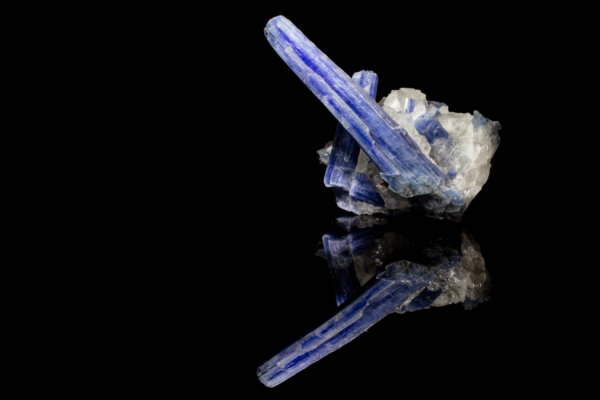
Kyanite is best known as a beautiful blue mineral, though it can also be white, gray, or green. It is a silicate of aluminum, and its name comes from the Greek word for blue. It usually grows as long, flat blades. An older name for it is disthene, from Greek words meaning two strengths, and that name points to its strangest feature.
Today
Kyanite is loved by collectors for its blue bladed crystals, and it is cut as a gem when clear enough. But it also has a serious industrial job. Heated strongly, kyanite changes into a tough material called mullite, which resists heat and is used to line furnaces and make spark plugs and fine ceramics. Few blue gems are also workhorses of industry.
Geology & Occurrence
Formation
Kyanite forms deep in the Earth, under great pressure. It grows when aluminum rich rocks are squeezed and heated during mountain building, in rocks such as schist and gneiss. Because it needs high pressure, its presence tells geologists that a rock was buried deep. It shares its recipe with two other minerals, andalusite and sillimanite, which form at lower pressures or higher heat.
Notable Localities
Kyanite comes from metamorphic rocks worldwide. Some of the finest deep blue blades come from Nepal and from Brazil. Switzerland and India also produce fine crystals, and good kyanite is found in the United States. The blue is often deepest at the center of a blade and paler toward the edge.
Kyanite has a test no other mineral can match. Its hardness is different in different directions. Drag a steel needle along the length of a blade and it scratches easily, but drag it across the blade and the needle barely makes a mark. That is why the old name disthene, two strengths, fits so well. This simple test alone can name the mineral.