Identity
Technical notes (click to open)(click to close)
Name & Human History
Etymology
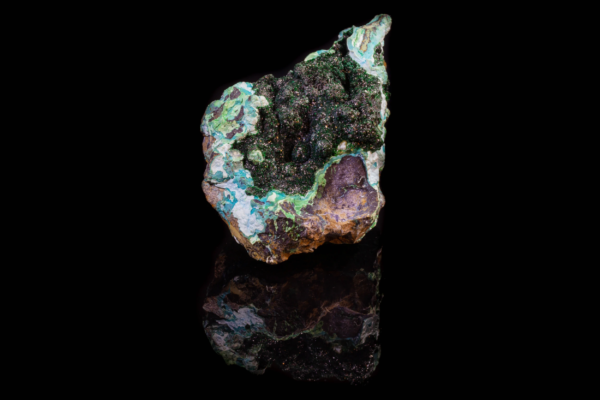
Malachite is a vivid green mineral, a carbonate of copper, famous for its banded patterns. Its name comes from a Greek word for the mallow plant, whose green leaves it was thought to match. It rarely forms good crystals. Instead it grows as smooth, rounded, grape like masses, which when cut reveal beautiful concentric rings of light and dark green.
Through the Ages
Malachite has served people for thousands of years. The ancient Egyptians mined it as one of the earliest ores of copper, ground it into green eye paint, and carved it into charms. Much later, Russian tsars lined whole rooms with polished malachite from the Ural mountains. Today it is mostly an ornamental and gem stone, prized for its rich green bands, and a useful sign of copper underground.
Geology & Occurrence
Formation
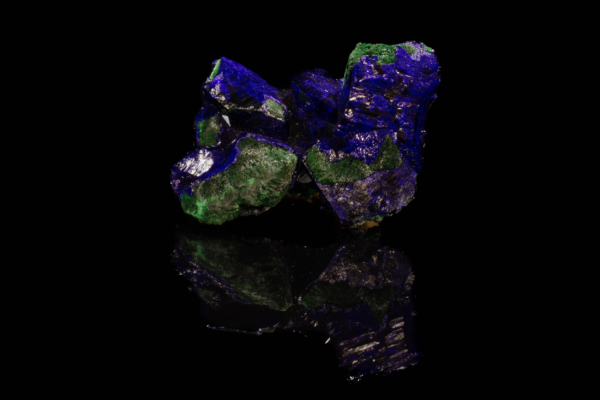
Malachite forms at the surface, where copper deposits weather. As copper rich water meets carbonate rock or air, it slowly builds up malachite in cracks and cavities. It often grows beside its blue cousin azurite, another copper carbonate. The slow, rhythmic way it forms is what gives it those famous bands.
Notable Localities
Malachite comes from copper deposits around the world. Today the finest botryoidal masses come from the Congo, in central Africa. Historic Russia, in the Ural mountains, produced enormous masses now largely worked out. Good malachite also comes from Namibia, Australia, Mexico, France, and Arizona. Each piece has its own pattern.
Malachite's bands are a record of its own growth. Each ring marks a pause and a fresh layer of green, added as the chemistry shifted over time. The shade depends on the size of the tiny needle crystals inside, so light and dark bands alternate. Cut and polished, no two pieces are ever the same, which is why malachite has long been treasured as a decorative stone.