Identity
Technical notes (click to open)(click to close)
Name & Human History
Etymology
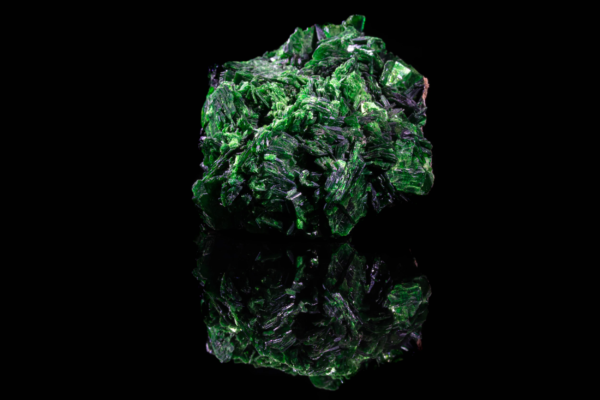
Metatorbernite is a green, radioactive mineral, a phosphate of copper and uranium. It grows as small square plates and scaly, micaceous crusts, with a vitreous to pearly shine and a color from pale to deep green. Its name means the meta, or altered, form of torbernite. It is what torbernite becomes when the mineral dries out and gives up part of its water.
Today
Metatorbernite is more common in collections than most people realize, because so much labeled torbernite has quietly turned into it. It is wanted for its green color and its place among the uranium minerals, but it must be handled with care, since it is radioactive. It has no use as a specimen beyond the collection, though its chemistry interests scientists.
Geology & Occurrence
Formation
Metatorbernite forms in the weathered, oxidized zone of uranium deposits, where copper and phosphate are present too. It grows there directly from solution, and it also forms a second way, by the slow drying of torbernite. As torbernite loses water to the air, its structure steps down to the more stable metatorbernite while keeping the same shape.
Notable Localities
Metatorbernite occurs wherever torbernite does, since one becomes the other. Classic material comes from Schneeberg in Saxony and from Jachymov in the Czech Republic, old mining districts famous for uranium minerals. It is also found in Portugal, in France, in the Democratic Republic of the Congo, in Australia, and in the United States.
Much of the torbernite in the world is not torbernite at all. Fresh torbernite holds twelve waters in its structure, but it holds them poorly: exposed to dry air, it slowly gives up four of them and becomes metatorbernite, dulling from bright to darker green as it goes. The change runs one way only, and it is common, so a great many specimens sold and cataloged as torbernite have long since crossed over.