Identity
Technical notes (click to open)(click to close)
Name & Human History
Etymology
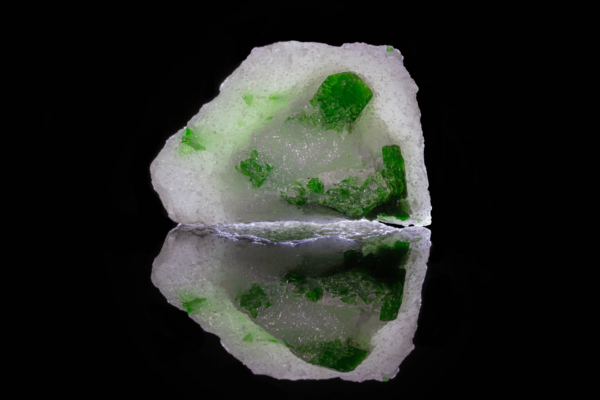
Pargasite is a green to black mineral of the amphibole family, a silicate of sodium, calcium, magnesium, and aluminum. It grows as stout prismatic to tabular crystals with a glassy shine, most often set in white marble. Its color runs from bluish green through dark green to nearly black. It was named in 1814 for Pargas in Finland, where it was first found.
Today
Pargasite is mostly a mineral for the specialist and the scientist. Clean green crystals in white marble make handsome specimens, and rare clear material has been cut as a gem. Its greater value is to geologists, who read it as a record of the heat, pressure, and water present when its host rock formed.
Geology & Occurrence
Formation
Pargasite forms where limestone is baked and altered, in the skarns and marbles that grow at the contact of hot igneous rock. It also appears in other calcium rich metamorphic rocks and in some volcanic rocks. It is a hydrous mineral, meaning water is built into its structure as hydroxyl.
Notable Localities
The type locality is Pargas in southwestern Finland, where dark crystals sit in marble. Good pargasite also comes from Sweden, Austria, and Italy, and clear green gem crystals have come from Tanzania and Myanmar. It occurs widely, but well shaped crystals are found in only a handful of places.
Pargasite is one of the oldest amphiboles still standing. It was named in 1814, in the earliest days of careful mineral chemistry, when the amphibole group was a tangle few could sort out. Two centuries of work have split that group into dozens of species and redrawn its boundaries again and again, yet pargasite has kept its name and its standing throughout.