Identity
Technical notes (click to open)(click to close)
Name & Human History
Etymology
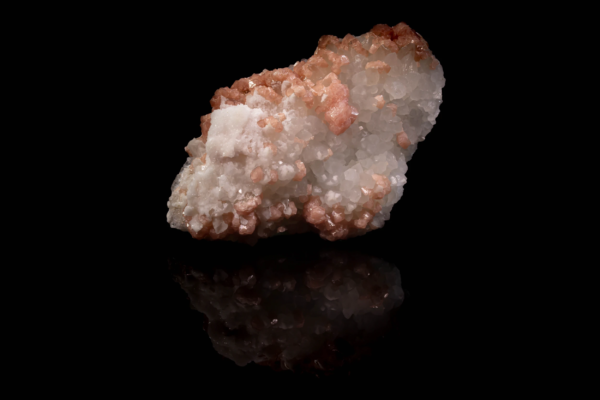
Rhodochrosite is a beautiful rose pink mineral, a carbonate of manganese. Its color ranges from soft pink to deep raspberry red, and that color is its glory. The name comes from two Greek words meaning rose colored. It is soft and easily scratched, so although it is sometimes cut as a gem, it is treasured most as a mineral specimen and a polished stone.
Through the Ages
Rhodochrosite shows two very different faces. In some places it grows as banded stalactites, which sliced and polished reveal lovely pink and white rings. People in old Inca lands knew this banded form, and it is still called Inca Rose. In rarer places it forms sharp, glassy, blood red crystals, the most prized of all, and a few are even cut into gems.
Today
Rhodochrosite is mostly a collector's stone and a gem, and a minor ore of manganese. Its rich pink is unmistakable, whether in a polished slab of banded Inca Rose or a single glassy crystal. Because it is soft, cut gems are delicate and meant for display rather than daily wear. Fine specimens are among the most sought after of all the pink minerals.
Geology & Occurrence
Formation
Rhodochrosite forms in veins and in altered rocks. It grows in hot mineral veins alongside ores of silver, lead, and zinc, and in rocks rich in manganese. The banded kind builds up slowly, layer by layer, as manganese rich water drips and flows through caves and old mine workings, much as ordinary stalactites form.
Notable Localities
Rhodochrosite comes from a few special places. The Sweet Home mine in Colorado yielded the world's finest red crystals, sharp rhombs that are now museum treasures. The Capillitas mine in Argentina is the home of the banded Inca Rose. South Africa, Peru, and Mexico have also produced superb deep red rhodochrosite.
Rhodochrosite is easily confused with rhodonite, and the names do not help, since both begin the same way and both are pink manganese minerals. But they are easy to tell apart. Rhodochrosite is a soft carbonate, often banded in pink and white, while rhodonite is a hard silicate, usually laced with black veins. This collection holds both, side by side, so the pair can be compared.