Identity
Technical notes (click to open)(click to close)
Name & Human History
Etymology
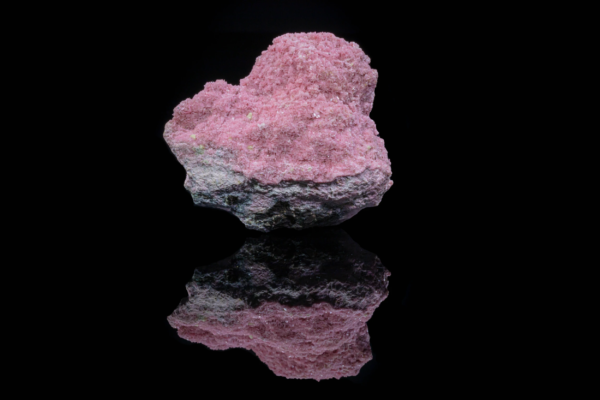
Rhodonite is a rose pink mineral, a silicate of manganese, often crossed by striking black veins. The pink comes from manganese, and the black veins are manganese oxide, formed as the surface slowly weathers. Its name comes from a Greek word for rose. It is much harder than its pink cousin rhodochrosite, hard enough to take a fine polish and wear well.
Today
Rhodonite is prized as a gem and an ornamental stone. Its rich pink, marbled with black, makes handsome cabochons, beads, and carvings. In Russia it was a favorite stone of the tsars, cut into bowls, boxes, and great decorative panels. Clear red crystals fine enough to facet are very rare and highly prized by collectors.
Geology & Occurrence
Formation
Rhodonite forms where manganese rich rocks are reshaped by heat and pressure. In these metamorphic settings it grows alongside other manganese minerals, sometimes with rhodochrosite and garnet. The black veins appear later, near the surface, as some of the manganese oxidizes and seeps along tiny cracks in the stone.
Notable Localities
Rhodonite comes from several classic places. The Ural mountains of Russia produced the famous ornamental rhodonite used in palaces. Australia, at Broken Hill, has yielded rare gem quality red crystals. Fine rhodonite also comes from Sweden, Brazil, Peru, and the United States, where it is the state gem of Massachusetts.
Rhodonite is easily mixed up with rhodochrosite, since both are pink manganese minerals with similar names. The simplest test is hardness. Rhodonite is a hard silicate that a knife will not scratch, while rhodochrosite is a soft carbonate that scratches easily. The black veins of rhodonite are another clue, since rhodochrosite is more often banded in pink and white.