Identity
Technical notes (click to open)(click to close)
Name & Human History
Etymology
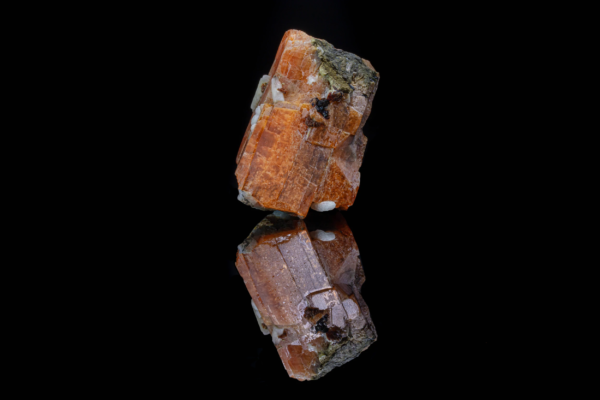
Serandite is a pink to salmon orange silicate of sodium, manganese, and calcium. It forms blocky, glassy crystals whose warm color comes from manganese, and the finest are a deep salmon red. It was discovered in 1931 on an island off Guinea and named for J. M. Serand, who helped collect the first specimens.
Today
Serandite is a collector's mineral, famous far beyond its rarity because of where the best ones come from. It has no industrial use. Its appeal is pure color and form: glowing salmon crystals, often perched on snow white analcime, a contrast that makes fine pieces some of the most prized in any collection of rare species.
Geology & Occurrence
Formation
Serandite forms in a rare kind of rock, an alkaline pegmatite, where an unusual magma rich in sodium cools slowly and leaves open cavities. In these pockets, sodium, manganese, and silica crystallize into serandite. It is the manganese rich end of a series that runs to pectolite, the calcium rich mineral it otherwise resembles.
Notable Localities
Serandite was first found in the Los Islands off Guinea, but one place made it famous: the Poudrette quarry at Mont Saint-Hilaire in Quebec, Canada. That single quarry, one of the richest mineral sites on Earth, produces nearly all the fine serandite collectors know, in crystals up to a hand's length.
The mineral and the man it honors shared a color. Serandite was named for J. M. Serand, a lighthouse keeper on an island off Guinea who helped gather the first specimens. The warm pink of the mineral matched something about the man: by the account handed down with the name, Serand himself had a notably rosy, pink complexion.