Identity
Technical notes (click to open)(click to close)
Name & Human History
Etymology
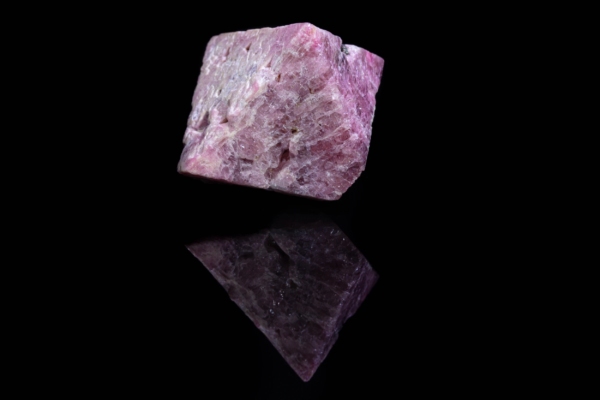
Spinel is an oxide of magnesium and aluminum, and one of the great gems long mistaken for others. It forms sharp, glassy octahedrons in nearly every color, from deep red through pink, blue, violet, and black. Its name comes from the Latin for a little thorn, after the pointed shape of its crystals. Most famous in red, it was for centuries confused with ruby.
Today
Spinel is a gem that has stepped out of ruby's shadow. Fine red and pink stones, once dismissed as lesser rubies, are now prized in their own right, and the vivid pink red of Myanmar and the cobalt blue of Vietnam command high prices. It is hard and bright, with no cleavage to weaken it, which makes it an excellent stone to wear.
Geology & Occurrence
Formation
Spinel forms mainly in marble, where limestone rich in magnesium and aluminum is cooked by heat and pressure. It grows there as sharp crystals scattered through the white rock. It also forms deep in the Earth, in the peridotite of the upper mantle, and its tough crystals survive weathering to gather in the gem gravels where much of it is found.
Notable Localities
The classic source is Mogok in Myanmar, home of the finest red spinel, the same marble country that produces ruby. Sri Lanka has yielded gem spinel from its gravels for centuries. Modern finds include the hot pink spinel of Mahenge in Tanzania and the blue spinel of Luc Yen in Vietnam, with more from Afghanistan, Tajikistan, and Madagascar.
Some of the most famous rubies in the world are not rubies at all. The Black Prince's Ruby, set at the front of the British Imperial State Crown, and the Timur Ruby, a 361 carat stone in the royal collection, are both spinels. For centuries kings and jewelers could not tell the two red gems apart, and the confusion was only settled once chemistry could separate them.