Identity
Technical notes (click to open)(click to close)
Name & Human History
Etymology
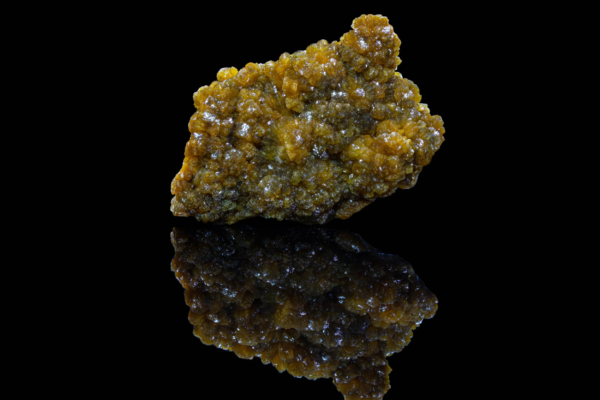
Stellerite is a zeolite, a calcium aluminum silicate that holds water inside an open, cage like structure. It usually forms as rounded, radiating clusters and sheaf like sprays of thin crystals, colorless to white, sometimes tinted pink or orange, with a pearly shine. It was named for Georg Wilhelm Steller, the German naturalist of an ill fated voyage to the North Pacific.
Today
Stellerite is a collector's zeolite, valued for its clean sprays and its warm pink to orange tints. It has no industrial use of its own, though the zeolite family it belongs to is prized for a remarkable trick: soaking up and giving back water, and sieving molecules by size. For the collector, the appeal is simply the delicate, glassy clusters.
Geology & Occurrence
Formation
Stellerite forms at low temperature inside volcanic rock. As warm water moves through cavities in basalt and andesite, long after the lava has cooled, it lays down zeolites in the old gas bubbles and cracks. Stellerite grows there alongside its close relatives, among them stilbite, with which it shares an almost identical chemistry.
Notable Localities
Stellerite was first found on the Commander Islands off Kamchatka in Russia, its type locality. The richest modern source is India, where the great basalt flows of the Deccan near Pune and Nashik have produced fine specimens. It also comes from Iceland, Scotland, and the United States, wherever old lava holds zeolite filled cavities.
The mineral carries a name shared by a whole menagerie. Georg Wilhelm Steller was the naturalist on Vitus Bering's doomed 1741 voyage, shipwrecked on the island where Bering died, the same islands this mineral comes from. In his brief time there Steller described animals that still bear his name: Steller's jay, Steller's sea eagle, Steller's sea lion, and Steller's sea cow, a giant creature hunted to extinction within thirty years of his finding it.