Identity
Technical notes (click to open)(click to close)
Name & Human History
Etymology
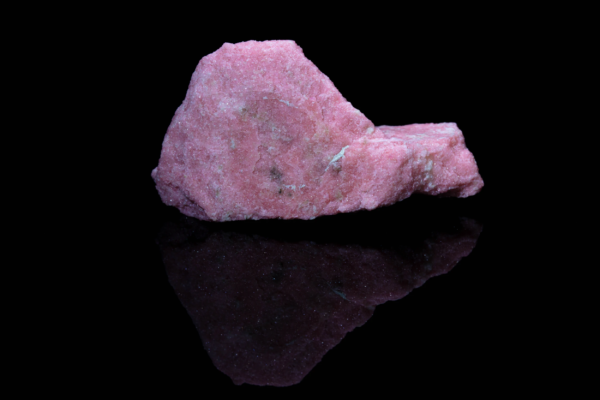
Thulite is the pink variety of zoisite, a calcium aluminum silicate, colored by a trace of manganese. The manganese turns the usually drab mineral a warm rose to deep pink. It is most often seen massive, carved and polished rather than as crystals. It was named for Thule, the mythical land at the far northern edge of the ancient world, after the Norway where it was first found.
Today
Thulite is used as an ornamental stone, cut into cabochons, beads, and small carvings, prized for its pink color flecked with pale veins. It is rarely transparent enough to facet. It is a Norwegian favorite, even named a national stone there, though it is found in a number of other countries as massive pink rock.
Geology & Occurrence
Formation
Thulite forms when rock is reworked by heat and pressure, where enough manganese is present to color the zoisite that grows. It appears in metamorphic rocks and in veins cutting them, usually as solid pink masses rather than clean crystals. Its parent mineral, zoisite, is a common product of this kind of metamorphism.
Notable Localities
Thulite was first found at Sauland in Telemark, Norway, in 1820, and Norway remains closely tied to it. Good material also comes from the United States, especially North Carolina, and from Australia, Austria, Italy, and Namibia. Most of it is sold as polished ornamental stone rather than as crystals.
Thulite's parent mineral leads a double, even triple life. Zoisite is a plain gray green rock most of the time, but a trace of one metal transforms it completely: manganese makes the pink of thulite, vanadium makes the blue violet of tanzanite, and chromium makes the green of the ruby bearing stone called anyolite. Three gems no one would guess were the same species.