Identity
Technical notes (click to open)(click to close)
Name & Human History
Etymology
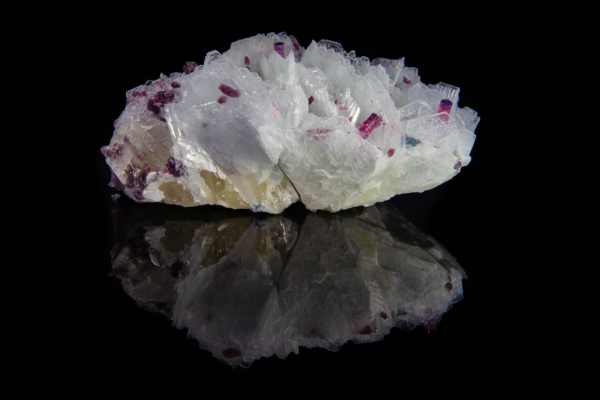
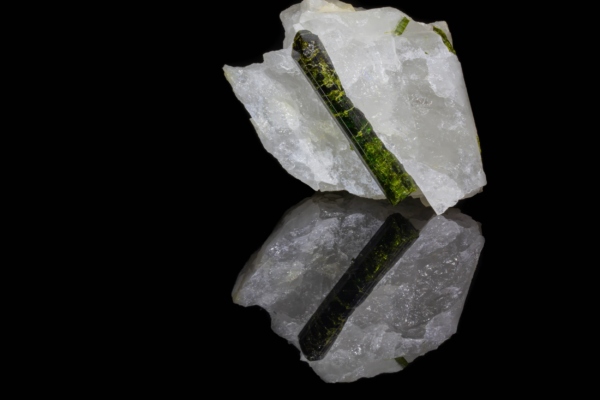
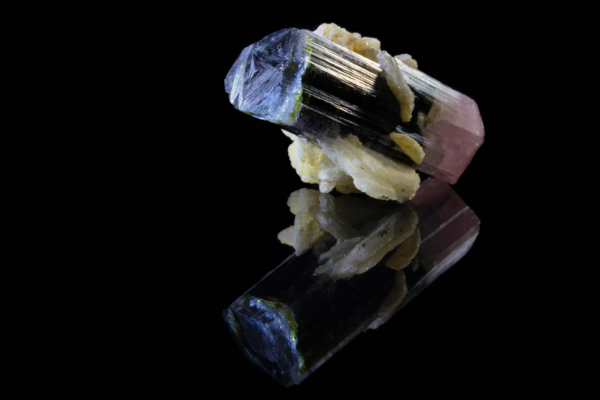
Tourmaline is not one mineral but a whole family, a group of boron silicates famous for their colors. No other mineral comes in so many. A single crystal can run from pink to green along its length, and the group covers nearly every shade there is. Its name comes from a word from Sri Lanka meaning, fittingly, mixed colored stones.
Today
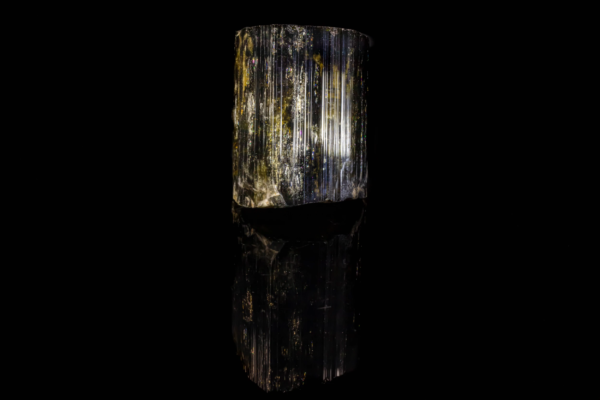
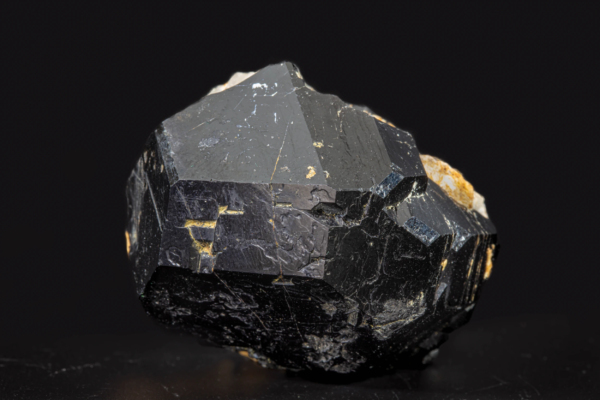
Tourmaline is one of the great gem families. Its colorful members, in pink, green, blue, and more, are cut into prized gems, and stones with a pink center and green rim are charmingly called watermelon tourmaline. The plain black kind, by contrast, is the most common of all, and is collected for its sharp, glassy, striated crystals.
Geology & Occurrence
Formation
Tourmaline forms in several settings. The colorful gem kinds grow in coarse veins called pegmatites, where rare elements gather. The common black kind grows in granites and in rocks reshaped by heat. Its long crystals, with a rounded triangular cross section and deep lengthwise grooves, are easy to know.
Notable Localities
Tourmaline is found around the world. Brazil is the great source of gem tourmaline, including a rare electric blue kind from Paraiba. Fine crystals also come from Afghanistan, Pakistan, California, and Madagascar. The black kind turns up in granite regions almost everywhere.
Tourmaline is a family of distinct minerals that share one structure. The black kind is schorl, the brown kind is dravite, and the colorful gem kind is elbaite, among others. Since they look so alike in form, the family name tourmaline is used for them all until the exact kind is known. Dravite, the brown magnesium member, is also held in this collection.