Identity
Technical notes (click to open)(click to close)
Name & Human History
Etymology
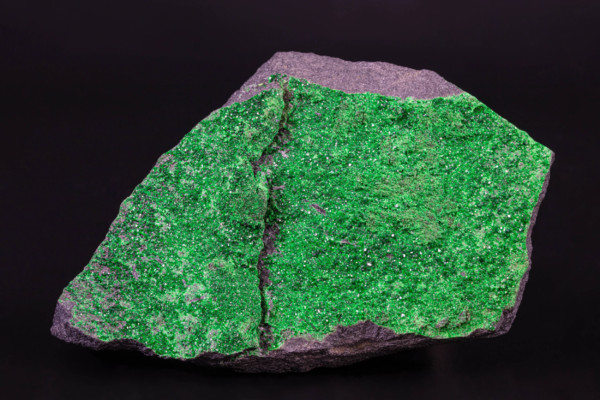
Uvarovite is a rare and lovely green garnet, a silicate of calcium and chromium. It is the only garnet that is always green, colored a vivid emerald shade by the chromium in it. It is named after Count Uvarov, a Russian statesman and mineral lover of the nineteenth century. It almost always grows as tiny, sparkling crystals.
Today
Uvarovite is a collector's delight. Its crystals are usually small, just a millimeter or two, but they gather into glittering green crusts on dark rock that catch the light beautifully. It is the rarest of the common garnets, and a good sparkling green druse is a prize, valued far more for display than for cutting into gems.
Geology & Occurrence
Formation
Uvarovite forms in chromium rich rocks. It grows where calcium rich fluids meet chromite, the main ore of chromium, in altered rocks deep underground. The chromium that gives it its green comes straight from that chromite, so uvarovite is nearly always found perched on or near it.
Notable Localities
Uvarovite comes from a few chromium districts. The Ural mountains of Russia, where it was first found, remain the classic source of bright green druses. An old copper mine at Outokumpu, in Finland, produced most of the museum specimens. It also occurs in Norway, Spain, Turkey, and California.
Uvarovite is the green garnet, the only one that owes its color to chromium, the same element that colors an emerald. But it has a catch. Its crystals are nearly always tiny. So if you are ever offered a large, clear, faceted green stone sold as uvarovite, treat it with suspicion. It is almost certainly a different green gem wearing a borrowed name.