Identity
Technical notes (click to open)(click to close)
Name & Human History
Etymology
Vesuvianite is a glassy silicate, most often green, brown, or yellow. It is a complex compound of calcium, aluminum, and other metals. It is named after Mount Vesuvius, the famous volcano in Italy, where it was first found. It is also known by an older name, idocrase, which is still used for its gem forms today.
Today
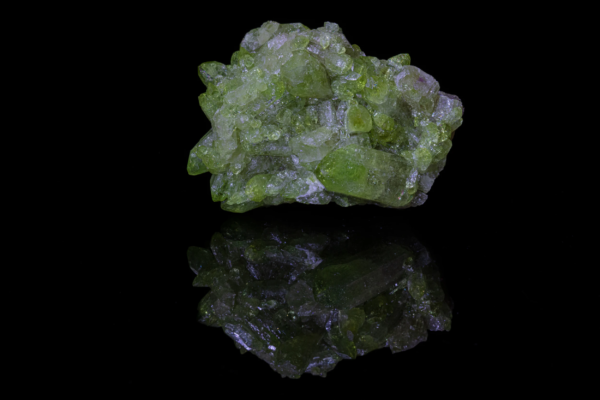
Vesuvianite is prized by collectors and is sometimes cut as a gem. Its glassy green crystals, with square cross sections, make handsome specimens. A massive green kind, called californite, looks so like jade that it is carved and sold in much the same way. Clear pieces are faceted into unusual gems.
Geology & Occurrence
Formation
Vesuvianite forms by contact metamorphism. This happens when hot magma bakes a body of limestone, reworking it into new minerals. Vesuvianite grows in the resulting rock, called skarn, alongside garnet, diopside, and other lime rich minerals. Good crystals are found in the cavities of these baked rocks.
Notable Localities
Vesuvianite comes from skarns around the world. Mount Vesuvius and the Ala valley in Italy are the classic homes of fine crystals. Superb specimens also come from Quebec in Canada, and the massive green californite comes from California. It is found in Switzerland, Russia, and Kenya as well.
Vesuvianite answers to two names. Mineral collectors call it vesuvianite, after the volcano where it was born, in blocks of limestone thrown out by Vesuvius long ago. Gem cutters more often call it idocrase. Both names point to the same stone, a quiet green crystal forged where molten rock met ancient limestone.