Identity
Technical notes (click to open)(click to close)
Name & Human History
Etymology
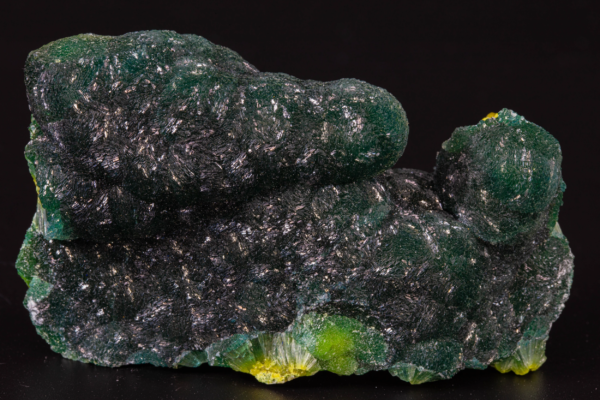
Wavellite is a green phosphate mineral best known for its lovely shape. It rarely forms plain crystals. Instead it grows as little balls and half spheres made of countless tiny needles that spread out from a center. Its color runs from pale to deep green, sometimes blue green or yellow. It is named after Dr. William Wavell, an English doctor who first brought it to the notice of mineral experts.
Today
Wavellite is mostly a collector's mineral, loved for its starbursts of green. A specimen often shows rows of small green domes on rock, like rounded buttons. Broken or cut across, each one reveals a pattern of fine needles radiating outward, like the spokes of a wheel or the petals of a flower. It has no real use beyond its beauty.
Geology & Occurrence
Formation
Wavellite forms as a secondary mineral, late and near the surface. It grows in cracks in aluminum rich rocks that have been gently altered, and in phosphate deposits, where water carries the right ingredients into open seams. There it slowly builds its little radiating balls on the rock face.
Notable Localities
Wavellite is found in several countries. It was first noticed in Devon, in England. The most famous specimens come from Arkansas, in the United States, where it forms superb green starbursts. Fine wavellite also comes from Bolivia, the Czech lands, and Brazil.
Wavellite hides a small surprise inside every ball. From the outside it looks like a simple green dome on the rock. But break one open, or cut it through the middle, and a beautiful sunburst appears. Hundreds of slender crystals fan out from the center to the rim, a hidden flower that formed slowly in the dark of the rock.