Identity
Technical notes (click to open)(click to close)
Name & Human History
Etymology
Adamite is a zinc mineral with a glow that makes it a favorite among collectors. The French chemist Charles Friedel named it in 1866. He did not name it for himself. He named it for Gilbert-Joseph Adam, a wealthy French collector who supplied the very first specimens. The mineral honors the man who brought it to science, a quiet custom that has named many minerals.
Today
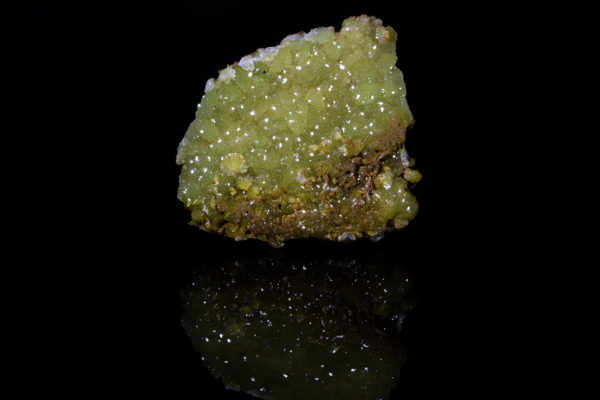
Adamite is mostly a collector's mineral today. It forms bright crystals in shades of yellow, honey, and green. They often crowd together in little fans and crusts on rusty brown rock. Many specimens glow a brilliant green under ultraviolet light, which has made adamite a star of fluorescent displays. Like other minerals that contain arsenic, it is handled with care and kept away from food and children.
Geology & Occurrence
Formation
Adamite forms late and near the surface, as a so called secondary mineral. It appears where older zinc ores slowly break down in air and water, and where arsenic is also present. The dissolved zinc and arsenic recombine in cracks and cavities to grow fresh adamite crystals. These often line the walls of a pocket. Its color shifts with the trace metals it carries. Iron tints it yellow, copper turns it green, and cobalt can push it toward pink or purple.
Notable Localities
The most famous adamite in the world comes from the Ojuela mine near Mapimi, in Durango, Mexico. There it grows in glowing yellow and green clusters. The mineral was first described from Chile, its original home. Fine pieces also come from the old mines at Lavrion in Greece, and from Tsumeb in Namibia, one of the great mineral localities on Earth.
Adamite is one of the standout stones of any fluorescent collection. In ordinary daylight a specimen may look like a soft yellow crust, pretty but quiet. Switch on an ultraviolet lamp in a dark room and the same piece blazes a vivid lime green. It can be bright enough to light up the table. Collectors who specialize in glowing minerals often build a whole display around a single fine adamite.