Identity
Technical notes (click to open)(click to close)
Name & Human History
Etymology
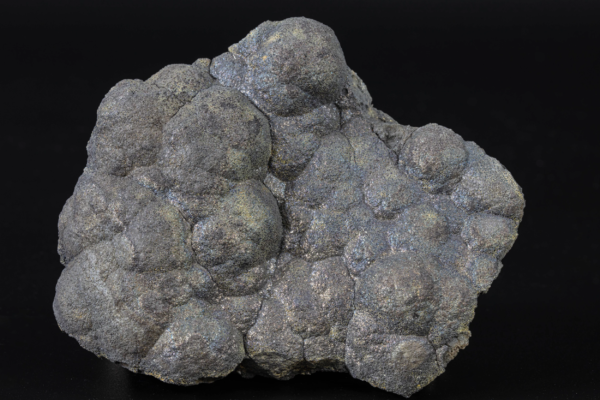
Arsenic is best known as a poison, but it is also a mineral in its own right. In nature it sometimes appears as the pure element, a heavy, brittle, gray solid. This is native arsenic. Like gold or copper, it is one of the few elements found uncombined in the earth. Unlike them, it is far from welcome, since even handling it calls for care.
Today
Native arsenic has no real use today beyond the collector's shelf. Even there it is treated with respect. Fresh surfaces show a silvery gray, but they quickly tarnish to a dull dark gray in air. The mineral is toxic. Specimens are kept sealed away and never licked or rubbed, and you wash your hands after touching one.
Geology & Occurrence
Formation
Native arsenic forms in hot underground veins, often in the company of silver. As the mineral rich fluids cool, the arsenic settles out. It rarely makes sharp crystals. Instead it grows as rounded, kidney shaped or grape like masses with a layered inside. It keeps company with silver ores and with its bright cousins realgar and orpiment, the red and gold arsenic minerals.
Notable Localities
Fine native arsenic comes from a handful of classic European mining districts. The old silver mines of Germany, in places like Sankt Andreasberg and Freiberg, are famous sources. The Czech towns of Jachymov and Pribram have produced excellent rounded masses, sometimes laced with red realgar. Good crystals are rare anywhere.
There is a simple, old test for arsenic minerals. Strike or heat them and they give off a sharp smell of garlic. That odor is the arsenic escaping, and it warns of the danger inside. Native arsenic has carried a dark reputation for centuries, the quiet poison of old tales of murder. Yet in the rock it is just a plain gray mineral that asks only to be left alone.