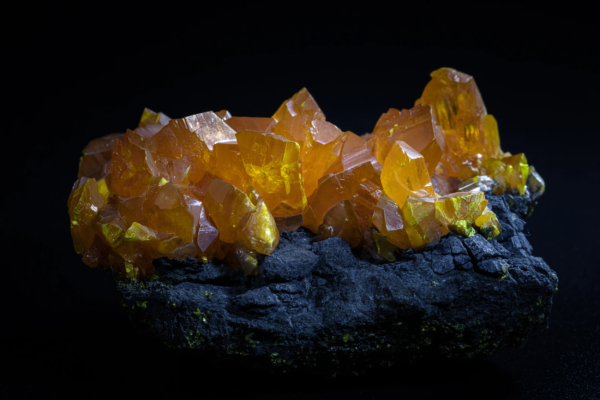
Identity
Technical notes (click to open)(click to close)
Name & Human History
Etymology
Orpiment carries gold in its very name. The word comes from the Latin auripigmentum. It joins aurum, for gold, with pigmentum, for color, so it means gold paint. The name points both to its rich golden yellow and to an old belief that the mineral held real gold inside. That hope made it a favorite of alchemists, who dreamed of pulling gold from its glowing crystals.
Through the Ages
Orpiment was one of the great yellows of the ancient world. Egyptians used it on papyrus more than three thousand years ago. It later colored paintings and manuscripts across Asia and Europe, sold as a pigment under the name king's yellow. Like its red cousin realgar, though, orpiment is an arsenic mineral and deeply toxic. Artists who loved its color still had to treat it as a poison, and it slowly fell out of use as safer yellows arrived.
Today
Orpiment is no longer used in paint, since modern yellows are brighter, cheaper, and far safer. It now belongs to the world of mineral collectors, who prize its warm golden color and its soft, almost glowing sheen. As with realgar, the beauty comes with a caution. Orpiment is toxic to handle, so it is admired more than it is touched, and it is kept well away from food.
Geology & Occurrence
Formation
Orpiment forms in the same quiet, low heat settings as realgar. It grows from warm arsenic rich water in rock fractures, around hot springs, and from volcanic gases. The two minerals are near constant companions. A single piece often shows both the gold of orpiment and the red of realgar side by side. Orpiment usually appears as bladed or flaky golden crystals, or as soft masses with a pearly shine where light catches the layers.
Notable Localities
Some of the best orpiment comes from China and from Peru, where rich golden crystals grow in silver and lead mines. The country of Georgia has a famous old source, and fine specimens also turn up in Nevada in the United States. A small Swiss quarry called Lengenbach is known among collectors for tiny but perfect arsenic minerals, orpiment among them.
Orpiment fooled some of history's most determined gold hunters. Its warm metallic yellow looked so much like the real thing that alchemists were sure it held gold. They spent lifetimes trying to coax the metal out of it, and they never could. The gold was only in the color. The glow that misled them comes from arsenic and sulfur, not from gold at all.
For all its beauty, orpiment was a hard pigment to live with. The color was glorious, but it could not be safely mixed with several other common paints of the day. Its arsenic also made grinding it a real risk to the painter. Some makers even cooked up a manufactured version to sell as king's yellow. In the end, no shade of gold was worth the danger, and the arrival of clean, bright yellow paints sent orpiment into retirement.