Identity
Technical notes (click to open)(click to close)
Name & Human History
Etymology
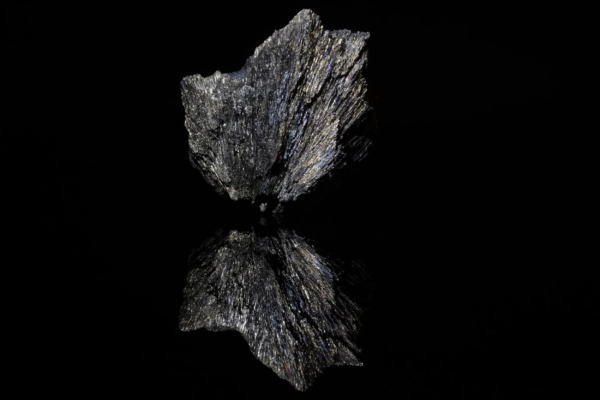
Berthierite is a dark, metallic mineral built from iron, antimony, and sulfur. It was first studied in France and named in 1827 for Pierre Berthier, a French chemist of the day. Fresh crystals are a bright steel gray, but they do not stay that way. In the open air they soon tarnish, taking on a shimmering rainbow film that browns over time. That changing surface is part of how collectors know it.
Today
Berthierite is mainly an ore of antimony, a metal once used to harden other metals and to make pigments and medicines. It was never the favorite ore, though. It holds less antimony than its cousin stibnite and is harder to process, so miners reached for stibnite first. Today berthierite is more of a collector's mineral, valued for its fine needle like sprays and its iridescent sheen.
Geology & Occurrence
Formation
Berthierite forms in mineral veins that run cool and low in sulfur. It grows there as slim, striated needles, often gathered into fans and feathery clusters or tangled fibrous masses. It keeps company with stibnite, quartz, and other vein minerals. Left exposed at the surface, it slowly rots into a dull brown crust of antimony and iron oxides.
Notable Localities
The best known berthierite comes from the mining region of Baia Mare in Romania, source of its finest crystals. France has many old localities too, especially in the Auvergne, where it was once a leading antimony ore. Good specimens also come from the Czech Republic, Germany, and Japan, usually from old antimony and silver workings.
Berthierite is a master of disguise. It looks so much like stibnite, the common antimony mineral, that the two are easily mixed up. There are ways to tell them apart. Stibnite crystals bend a little under pressure, while berthierite snaps. Berthierite also leaves a brown mark when scratched, where stibnite leaves a lead gray one. The names cause trouble too, since a totally different mineral, berthierine, also honors Pierre Berthier.