Identity
Technical notes (click to open)(click to close)
Name & Human History
Etymology
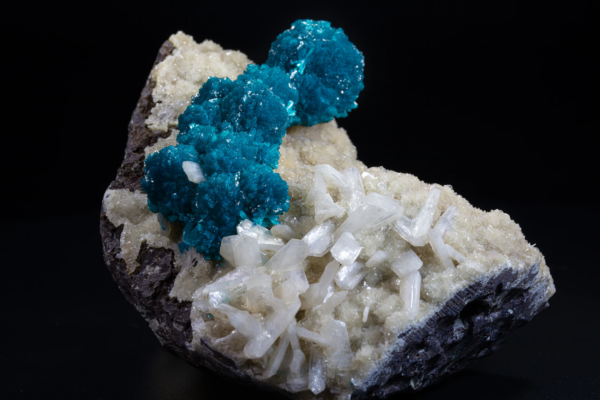
Cavansite is one of the most vividly blue minerals in the world. Its name is a clever shorthand. The mineral is built from calcium, vanadium, and silicon, and the name strings together pieces of those three words. Scientists described it in 1967 from a dam site in Oregon. Its electric blue color comes from vanadium, not from copper as many people first assume.
Today
Cavansite is rare, and it lives almost entirely in the world of collectors. It is too soft and too scarce for jewelry, but a fine piece is a showstopper. The most prized specimens are tight balls of brilliant blue crystals, like tiny blue flowers. They rest on beds of pale, sparkling zeolite. The contrast of vivid blue against creamy white is what makes these pieces so striking.
Geology & Occurrence
Formation
Cavansite grows inside old lava. As gas bubbles in cooling basalt leave empty pockets, mineral rich water fills them and crystals form. Cavansite crystallizes there, usually as rosettes of fine blue blades. It grows alongside a whole family of minerals called zeolites. The same kind of rock that holds zeolites and apophyllite is where cavansite likes to grow.
Notable Localities
The mineral was first found in Oregon, which remains its official home. But the finest cavansite in the world comes from India. The basalt quarries near Pune, in western India, have produced spectacular blue rosettes since the 1980s. Only a few quarries there yield it. As they close one by one, good cavansite is becoming harder to find.
Cavansite has a near twin called pentagonite. The two share the exact same recipe but stack their atoms differently, so they grow into different shapes. Cavansite forms rounded rosettes, while pentagonite forms star shaped clusters. Pentagonite is even rarer than cavansite. Telling the two apart can take a careful eye, since their blue colors are so much alike.