Identity
Technical notes (click to open)(click to close)
Name & Human History
Etymology
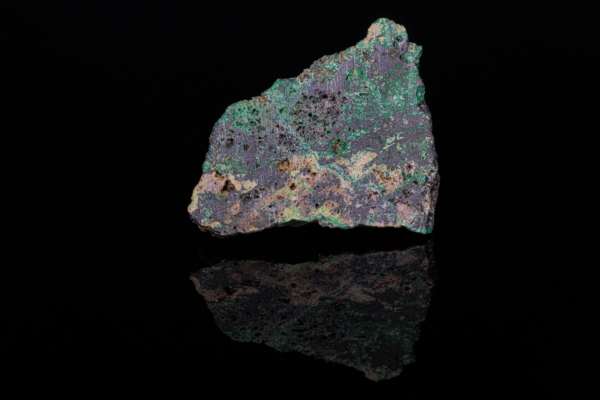
Chalcomenite is a rare blue mineral made of copper, selenium, oxygen, and water. Chemists call it a copper selenite. Its name joins two Greek words: chalkos, meaning copper, and mene, meaning moon. The moon is there because the element selenium was itself named after Selene, the Greek goddess of the Moon. So the name of this small blue crystal reads, roughly, copper moon.
Discovery
Chalcomenite was described in 1881 by two French mineralogists, Alfred Des Cloizeaux and Augustin Damour. Their samples came from Cerro de Cacheuta, a hill southwest of the city of Mendoza in Argentina, where miners had long before found small veins of lead selenide. Among those veins sat tiny bright blue crystals that no one had named. The original specimens are still kept at the National Museum of Natural History in Paris.
Today
Chalcomenite has no industrial use. It is a collector's mineral, wanted by people who gather rare selenium species. Most specimens show only small crystals or thin crusts, but their color is a strong, clear blue that stands out against dark selenide ore. Fine crystals are scarce, and a few localities supply nearly all of them.
Geology & Occurrence
Formation
Chalcomenite is a secondary mineral. It does not form deep underground but near the surface, when copper selenides meet air and water. As those dark minerals weather, the selenium joins with oxygen and the copper, and blue crystals of chalcomenite grow in cracks and cavities. It keeps company with other selenium minerals, such as umangite and clausthalite, and with copper minerals like malachite.
Notable Localities
Argentina is its homeland. Besides the original Cerro de Cacheuta in Mendoza, it is found in the selenium veins of La Rioja Province, at the Condor mine in the Los Llantenes district, in the Sierra de Umango, and in the Sierra de Famatina. Bolivia has produced good crystals at the El Dragon mine near Potosi. The Baccu Locci mine in Sardinia, Italy, is known for large crystals. It also turns up in Congo, Arizona, Germany, and Cornwall.
The place where chalcomenite was discovered has been lost. Cerro de Cacheuta gave the world several new selenium minerals in the 1800s, but no one today knows exactly where its veins were. A 2018 study of the Cacheuta selenium minerals noted that the occurrence has never been found again, so the type locality of chalcomenite now survives only in old collections.