Identity
Technical notes (click to open)(click to close)
Name & Human History
Etymology
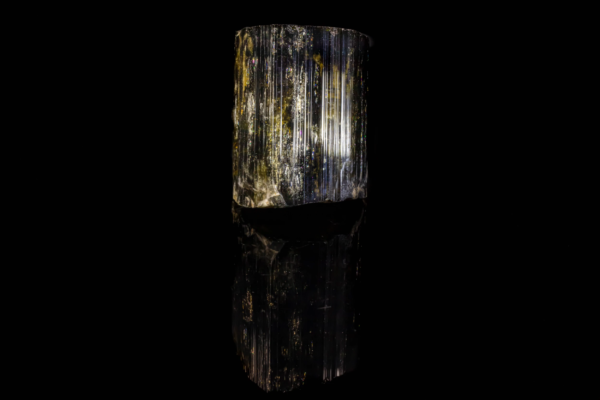
Elbaite is the gem tourmaline, the species behind most of the colorful tourmalines collectors and jewelers prize. A sodium lithium aluminum borosilicate, it forms long, striated, three sided prisms in a wider range of color than almost any other mineral. It was named for the island of Elba in Italy, where it was first described in 1913.
Today
Elbaite is one of the great colored gems. Its varieties have their own names: rubellite for red and pink, indicolite for blue, verdelite for green, and watermelon for crystals that are pink inside and green outside. The electric blue green Paraiba tourmaline, colored by copper, is among the most expensive gems in the world by weight.
Geology & Occurrence
Formation
Elbaite grows in granite pegmatites, the coarse veins where the last, water rich melt of a cooling granite crystallizes. These fluids are rich in the boron, lithium, and rare elements elbaite needs, and the open pockets give its crystals room to grow large and clear. It is the tourmaline of these lithium rich pegmatites.
Notable Localities
Named for Elba, elbaite is now mined far more widely. Brazil, especially Minas Gerais, is the great source, and the copper bearing Paraiba stones come from there and from Mozambique and Nigeria. Other fine tourmaline comes from Afghanistan, Pakistan, Madagascar, and from the historic pegmatites of San Diego County in California.
Tourmaline builds up a charge. Heat an elbaite crystal or squeeze it, and the two ends take on opposite electric charges, drawing dust and bits of ash toward it. Dutch traders in the 1700s knew this well: they used tourmaline to pull the ash from their pipes and called it aschentrekker, the ash puller, long before anyone understood the physics behind it.