Identity
Technical notes (click to open)(click to close)
Name & Human History
Etymology
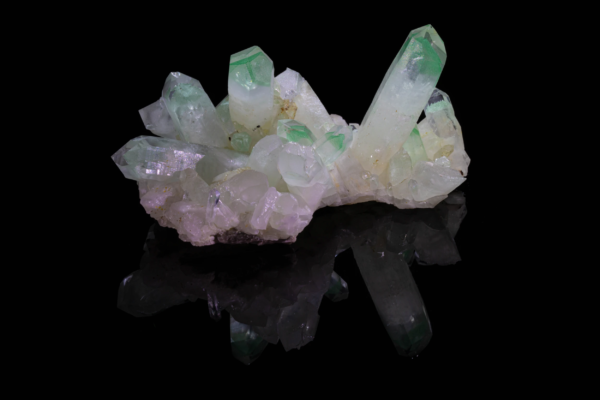
Fuchsite is the green variety of muscovite, the common pale mica, turned a vivid green by chromium. As chromium slips into the crystal in place of aluminum, the color deepens from a soft green to a rich, near emerald shade. It shares muscovite's soft, pearly, easily split plates. It was named in 1842 for Johann Nepomuk von Fuchs, a German chemist and mineralogist.
Today
Fuchsite is valued for its color and its sparkle. It rarely forms good crystals, appearing instead as glittering green flakes and scaly masses, and it is soft, so it is carved and polished rather than faceted. Rock made almost entirely of fuchsite, called verdite, is used for ornamental carving, and green fuchsite is often set with small red crystals of ruby.
Geology & Occurrence
Formation
Fuchsite forms during metamorphism, when rock is reshaped by heat and pressure and chromium happens to be present. It is typical of greenschist, a green metamorphic rock named in part for this very mica. It also grows in quartzite and schist, usually as tiny flakes spread through the rock rather than as separate crystals.
Notable Localities
Fuchsite is found worldwide wherever chromium rich rocks are metamorphosed. Notable material comes from Brazil, India, and Russia, and verdite is carved in southern Africa. Fine ruby in fuchsite, red corundum set in green mica, comes from India. It occurs in the United States, Austria, and many other places as scattered green flakes.
In some of the world's old gold country, green mica is a clue worth reading. Where chromium colors muscovite into fuchsite, it can stain the same rock that happens to carry gold, and prospectors long ago learned to slow down when the stone turned green. The mica itself holds no gold, but it keeps company with it, a green flag over hidden metal.