Identity
Technical notes (click to open)(click to close)
Name & Human History
Etymology
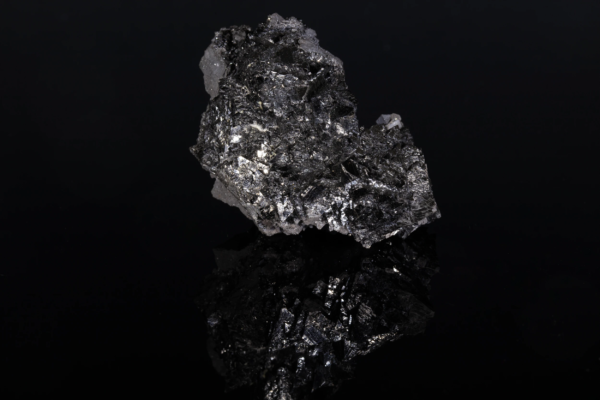
Hausmannite is a dark, brown black mineral made of manganese and oxygen. It has a submetallic shine, almost like dull steel. The mineral was named in 1827 to honor a German scientist, Johann Hausmann. He studied minerals at Göttingen. Hausmannite often grows as small, sharp crystals shaped like stubby double pyramids. These are often twinned into neat, stepped groups.
Today
Hausmannite is valued as an ore of manganese, the metal that toughens steel. Most of the world's manganese is used to make stronger, harder steel. Hausmannite is one of the minerals it comes from. For collectors, though, hausmannite is loved for its crystals. The best are sharp, lustrous, and well shaped, a real prize from a mineral that is often just a dull black mass.
Geology & Occurrence
Formation
Hausmannite forms where manganese deposits are cooked by heat. It grows during metamorphism, when older manganese ores are reshaped by heat and pressure. It also grows from hot fluids in veins. It is often found with other manganese minerals and with calcite. The finest crystals grew in just this way, deep in ancient manganese rich rocks.
Notable Localities
The world's best hausmannite by far comes from South Africa. In the vast Kalahari manganese field, the N'Chwaning and Wessels mines have produced superb crystals. They are deep and lustrous, far better than anywhere else. Good hausmannite also comes from Sweden, Germany, and Italy. But the South African crystals set the standard that collectors chase.
Hausmannite shows a quiet lesson in how crystals grow. Many of its crystals are twins, where two or more crystals grow joined in a regular way. In hausmannite this often makes neat, stepped, staircase like edges on the little pyramids. These twins are not flaws. They are a natural part of how the mineral builds itself, and a sharp twinned cluster is a thing of real beauty.