Identity
Technical notes (click to open)(click to close)
Name & Human History
Etymology
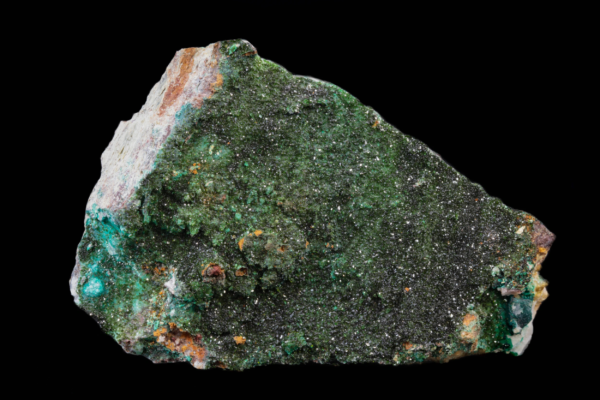
Libethenite is a small but handsome green mineral, a phosphate of copper. Its color ranges from olive green to a deep, almost blackish green. It grows as little glassy crystals shaped like short pyramids, or as green crusts on rock. It was named in 1823 after the place it was first found, Ľubietová in Slovakia. That town was once known by its German name, Libethen.
Today
Libethenite is an uncommon mineral, valued by collectors who enjoy the small treasures of copper deposits. Its crystals are usually tiny, often best seen with a loupe. But they can be sharp, glassy, and a rich green. A crust of bright green libethenite on dark rock makes a quietly beautiful specimen for those who look closely.
Geology & Occurrence
Formation
Libethenite forms at the surface, in the oxidized zone of copper deposits. As copper minerals weather, phosphorus is freed from the breakdown of minerals like apatite. The two then join to build libethenite. It grows with other green copper minerals such as malachite, lining cracks and cavities in the weathered ore.
Notable Localities
Libethenite is found at copper deposits around the world. The type locality in Slovakia produced fine old crystals. Some of the best modern specimens come from the copper deposits of the Congo. Good libethenite also comes from Portugal, from Arizona, and from Australia. It is usually found as small crystals in the oxidized parts of the ore.
Libethenite has a close twin built on a simple swap. Take its recipe and trade the phosphate for arsenate, a related ingredient. The result is a green mineral called olivenite. The two share almost the same shape and color, and form a smooth series between them. Libethenite is the phosphate end, and olivenite the arsenate end, of one closely linked pair.