Identity
Technical notes (click to open)(click to close)
Name & Human History
Etymology
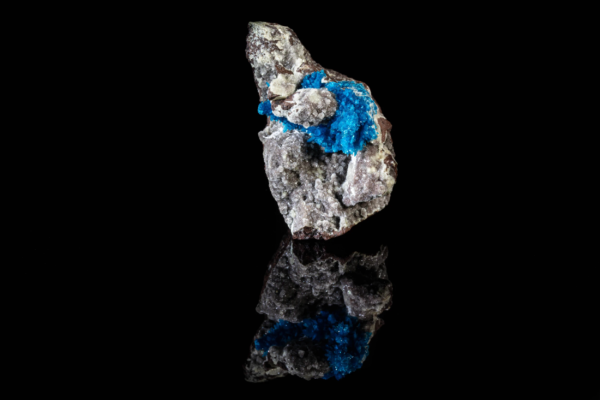
Pentagonite is a rare silicate of calcium and vanadium, prized for one of the purest blues in the mineral world. It grows as slender prismatic crystals, usually gathered into radiating sprays and rosettes on pale rock. It takes its name from its crystals, which twin together into star shapes with an apparent five sided symmetry.
Today
Pentagonite is a collector's mineral and nothing else. It has no industrial use, and its crystals are small. What it offers is color and form: bright blue stars scattered across white zeolite. It is far rarer than its blue relative cavansite, which makes fine pentagonite genuinely hard to find.
Geology & Occurrence
Formation
Pentagonite grows at low temperature inside old lava. As warm water moves through cavities in basalt, it lays down zeolites and, more rarely, pentagonite and its dimorph cavansite. The two share one chemistry but not one structure, and they often sit side by side in the same rock, born of the same fluid.
Notable Localities
Pentagonite was first found at Owyhee Dam in Oregon, its type locality. By far the greatest source is the Wagholi quarries near Pune in India, where nearly all fine specimens have come from. Those quarries are closing, so good pentagonite is becoming scarcer and dearer.
Pentagonite has a twin that is not really a twin. It shares its exact chemistry with another mineral, cavansite, atom for atom, yet the two are counted as different species because their atoms are stacked in different patterns. The two can even grow in the same cavity, the same shade of blue, told apart only by shape and a careful eye.