Identity
Technical notes (click to open)(click to close)
Name & Human History
Etymology
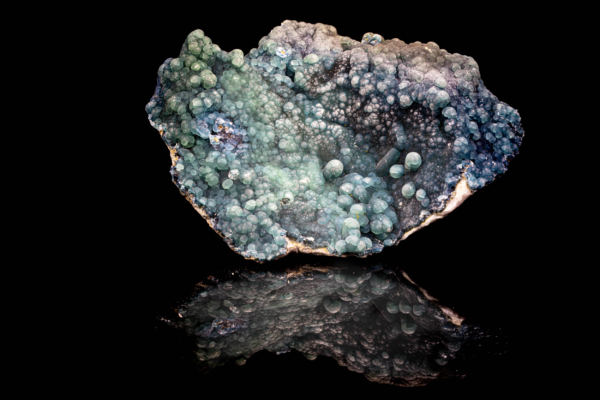
Plumbogummite is a secondary phosphate of lead and aluminum. It rarely forms real crystals, appearing instead as smooth, rounded, gummy looking crusts and coatings, often a soft blue but also gray, yellow, or brown. Its name joins the Latin words for lead and for gum, a nod to its lead content and its gum like look.
Today
Plumbogummite is a collector's curiosity, valued most when it coats something else. Its best known role is as a blue crust over green pyromorphite, a color pairing collectors prize. On its own it is a modest mineral, but it carries lead, so it should be handled with a little care.
Geology & Occurrence
Formation
Plumbogummite forms at the surface, in the weathered, oxidized zone of lead deposits. As lead minerals break down and meet aluminum and phosphate in cool water, plumbogummite grows as crusts and rounded masses, often directly on top of earlier lead minerals. It belongs to the crandallite group.
Notable Localities
Classic plumbogummite comes from the Caldbeck Fells in Cumbria, England, and from Leadhills in Scotland, old lead districts rich in secondary minerals. It is also found at Huelgoat in France. More recently, striking blue plumbogummite over green pyromorphite has come from Yangshuo in China.
Plumbogummite often shows up wearing another mineral's clothes. It commonly forms as a blue skin over green pyromorphite, coating each crystal so completely that a piece can look like a single new mineral. The prized specimens from China are exactly this, blue laid over green, one lead mineral quietly dressing another.