Identity
Technical notes (click to open)(click to close)
Name & Human History
Etymology
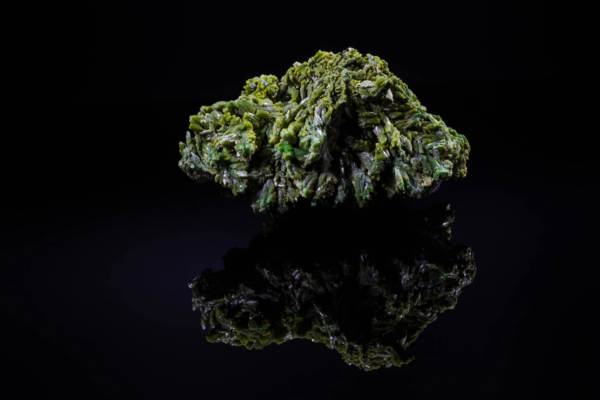
Pyromorphite is a phosphate of lead, famous among collectors for its color: bright apple green, grass green, and yellow green, sometimes orange or brown. It grows as glassy prismatic crystals, often shaped like little barrels and gathered into crusts. Its name comes from the Greek words for fire and form.
Today
Pyromorphite is a favorite green mineral, wanted for its color, its glassy shine, and its neat barrel crystals. It was once mined as an ore of lead. Today it is a specimen mineral above all, though because it carries lead it should be handled with clean hands and kept from being ground to dust.
Geology & Occurrence
Formation
Pyromorphite forms at the surface, in the weathered, oxidized zone of lead deposits. As lead minerals break down and meet phosphate in cool water, pyromorphite crystallizes in cracks and cavities. It belongs to a series with mimetite, which carries arsenic in place of phosphate, and with vanadinite, which carries vanadium.
Notable Localities
Classic pyromorphite comes from Germany, from the Bad Ems and Bad Grund districts, and from Les Farges in France. Fine green crystals have long come from Cumbria in England and from the Bunker Hill mine in Idaho. In recent decades, superb bright green pyromorphite has poured out of Guangxi in China.
The name means fire form, and it comes from an old blowpipe test. Melt a grain of pyromorphite in a flame and let it cool, and it does not stay a shapeless bead: it draws itself back into tiny crystal faces as it hardens. Early mineralogists watched the cooling melt take shape again and named the mineral for it.