Identity
Technical notes (click to open)(click to close)
Name & Human History
Etymology
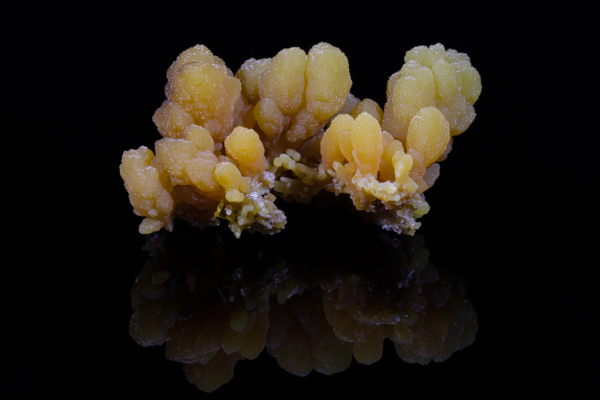
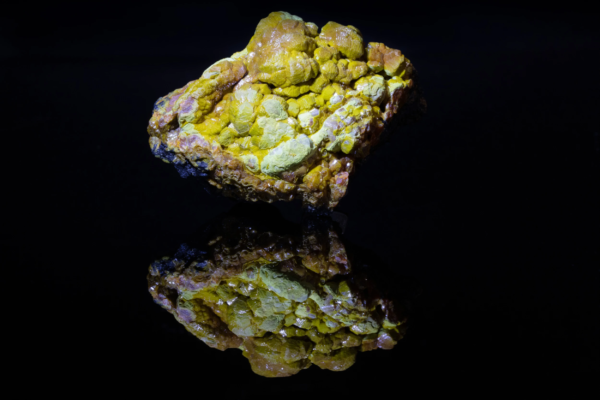
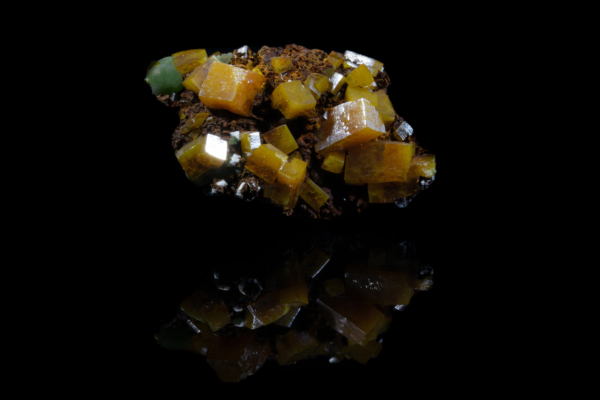
Mimetite is a heavy mineral of yellow to orange, a compound of lead, arsenic, and chlorine. It often grows as small barrel shaped crystals. It also forms rounded, glassy crusts that look a little like cauliflower. Its name comes from a Greek word meaning imitator, because it closely copies another mineral, pyromorphite. The two can be very hard to tell apart.
Today
Mimetite is mostly a collector's mineral, prized for its warm color and glassy, rounded forms. It is only a minor ore of lead, since it is fairly rare. Its best pieces are clusters of small yellow or orange globes that glow warmly on dark rock. It holds both lead and arsenic, so wash hands after handling it and never grind or breathe its dust.
Geology & Occurrence
Formation
Mimetite forms at the surface, in the weathered zone of lead deposits. As lead ore such as galena slowly breaks down, and as arsenic joins in, mimetite is built up in cracks and cavities. It grows there with other secondary lead minerals such as wulfenite, cerussite, and vanadinite.
Notable Localities
Mimetite comes from oxidized lead deposits worldwide. Some of the finest yellow and orange specimens come from Mexico, especially near Durango and Chihuahua. The famous Tsumeb mine in Namibia has produced superb crystals. Good mimetite also comes from England, Germany, Arizona, and China.
Mimetite earns its name as a great imitator. It belongs to a trio of lead minerals that swap one ingredient among themselves. Mimetite holds arsenic, pyromorphite holds phosphorus, and vanadinite holds vanadium. Otherwise they are nearly the same. Their colors overlap, so a piece can fool the eye, and sometimes only a laboratory can say which is which.