Identity
Technical notes (click to open)(click to close)
Name & Human History
Etymology
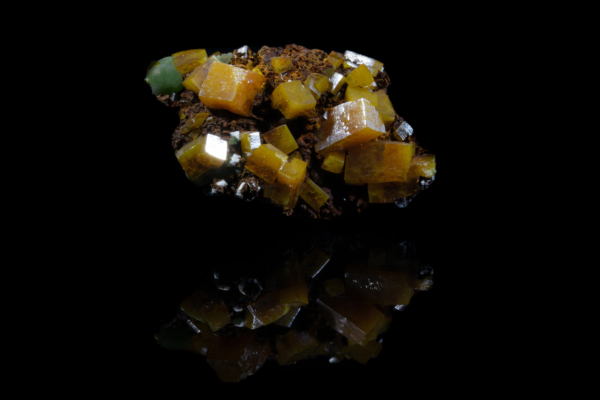
Wulfenite is a brilliant orange mineral, a compound of lead and molybdenum. Its glowing orange to yellow crystals are among the most eye catching of all minerals. It usually grows as thin, square, tabular plates, like little wafers scattered across the rock. Because it holds lead, it is wise to wash hands after handling it and never to grind its dust.
Today
Wulfenite is a minor ore of molybdenum and a great favorite of collectors. Molybdenum is a metal used to toughen steel, but most wulfenite is far too scarce and scattered to mine. Its real fame is its color. A cluster of thin, fiery orange crystals on dark rock is one of the most prized sights in the mineral world.
Geology & Occurrence
Formation
Wulfenite forms at the surface, in the weathered zone of lead deposits in dry country. As lead ore breaks down and molybdenum washes in, the two join to build wulfenite. It grows in cracks and cavities with other secondary minerals, including vanadinite, often in the same arid mining districts.
Notable Localities
Wulfenite comes from oxidized lead deposits in arid lands. The most famous is the Red Cloud mine, in Arizona, prized for its thick, deep red orange crystals. Large crystals come from Los Lamentos in Mexico, and fine yellow wulfenite comes from Mezica in Slovenia. Good material also comes from Morocco.
Wulfenite reaches its peak at one small Arizona mine. The Red Cloud mine has produced the finest wulfenite on Earth, thick tablets of a deep, glowing red orange that collectors chase for a lifetime. A single fine Red Cloud crystal can be worth a small fortune. It often grows beside vanadinite, the red lead vanadate also held in this collection.