Identity
Technical notes (click to open)(click to close)
Name & Human History
Etymology
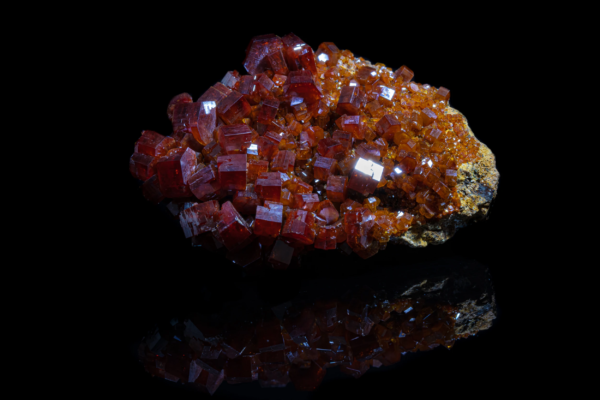
Vanadinite is a striking red mineral, a heavy compound of lead and vanadium. Its glassy, bright red to orange crystals are among the most colorful in the mineral world. It grows as small six sided prisms, often scattered like jewels across a pale rock. Because it holds lead, it is wise to wash hands after handling it and never to grind its dust.
Today
Vanadinite is both an ore and a star of any collection. It is a leading ore of vanadium, a metal used to toughen steel, and a minor source of lead. But its real fame is its beauty. Bright red hexagonal crystals on a contrasting matrix make some of the most sought after specimens in the hobby.
Geology & Occurrence
Formation
Vanadinite forms at the surface, in the weathered zone of lead deposits in dry country. As lead ore such as galena breaks down, and as vanadium washes in from the surrounding rock, the two join to build vanadinite. It grows in cracks and cavities with other secondary lead minerals.
Notable Localities
Vanadinite comes from oxidized lead deposits in arid lands. By far the most famous are the mines of Mibladen, in Morocco, which yield brilliant red crystals on white barite. Fine vanadinite also comes from Tsumeb in Namibia, from Arizona, and from Mexico.
Vanadinite carries the memory of a lost element. Long ago a Spanish scientist in Mexico found a strange brown lead ore and believed it held a new metal. Doubt crept in, and he gave up the claim. Years later the metal was found again and named vanadium, and the brown ore proved to be its mineral. It is a cousin of mimetite, the lead arsenate also held in this collection.