Identity
Technical notes (click to open)(click to close)
Name & Human History
Etymology
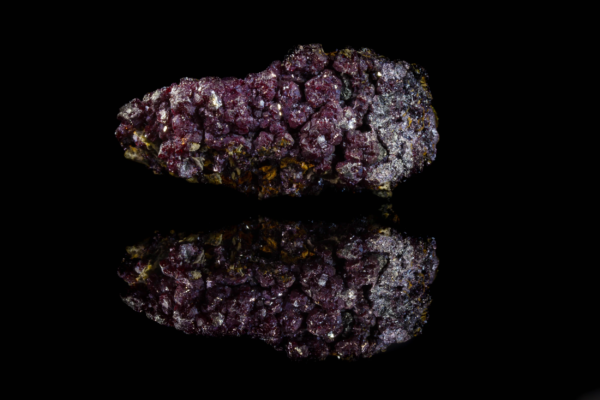
Proustite is a sulfosalt of silver and arsenic, and one of the most beautiful red minerals known. Fresh crystals are a clear scarlet, glassy and almost gem like, which earned it the old miners' name ruby silver. It was named for Joseph Louis Proust, the French chemist who showed that compounds combine in fixed proportions.
Today
Proustite is a famous but frustrating mineral. A clean red crystal is a spectacular thing, and it was once a real ore of silver, but its beauty does not keep. Exposed to light, the clear red slowly darkens to gray and black, so the finest pieces are kept in the dark and brought out only briefly.
Geology & Occurrence
Formation
Proustite forms in silver veins, among the last minerals to crystallize as the veins cool. It grows where silver, arsenic, and sulfur come together, often alongside native silver and other silver minerals. The best crystals line open pockets in the vein.
Notable Localities
The greatest proustite came from Chanarcillo in Chile, a legendary silver district whose crystals set the standard. Superb material also came from the old silver mines of Saxony, at Freiberg and Schneeberg, and from Jachymov in the Czech Republic. Cobalt, in Ontario, Canada, is another notable source.
The mineral carries the name of Joseph Louis Proust, who in the early 1800s proved a simple and powerful idea: that a chemical compound always holds its elements in the same fixed ratio, no matter how it is made. It is a fitting honor for a mineral of exact composition, though Proust the chemist almost certainly never saw the blazing red crystal that now bears his name.