Identity
Technical notes (click to open)(click to close)
Name & Human History
Etymology
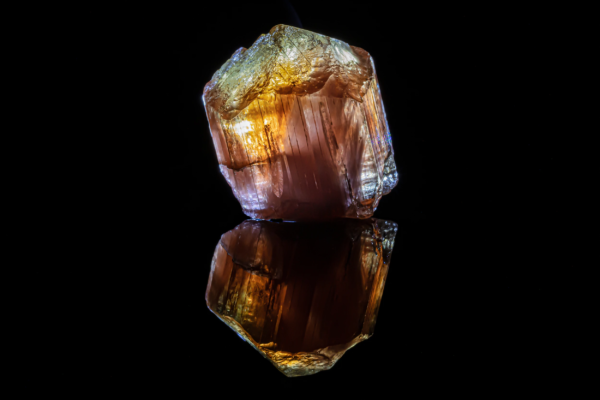
Scapolite is not a single mineral but a small family. It is a series of aluminum silicates that grade from one kind into another. The name comes from a Greek word for a rod or shaft, after the long, square sided prisms it often forms. Its color ranges from white and gray to yellow, pink, and violet. The gem grades have a soft glassy shine. The members look so alike that they are usually just called scapolite.
Today
Scapolite is both a rock builder and a gem. In its plain gray, fibrous form it is a common mineral of certain altered rocks. There it is of interest mainly to geologists. But clear yellow and purple crystals are cut into gems, and some show a cat's eye glow. Many scapolites also glow a warm yellow or orange under ultraviolet light, which makes them favorites with collectors.
Geology & Occurrence
Formation
Scapolite forms mostly in metamorphic rocks. It often grows where limestone has been baked and altered near a hot igneous body. It also grows where salty fluids have reworked feldspar deep underground. Its makeup records the chemistry of those fluids. So geologists read it as a clue to the conditions in which it grew.
Notable Localities
Scapolite is found around the world in metamorphic terrains. Fine gem crystals come from the gem gravels of East Africa, in Tanzania and Kenya, and from Myanmar. Large prismatic crystals come from Canada, especially Quebec and Ontario. Glassy crystals of the calcium rich kind occur in the old lavas of Vesuvius, in Italy.
Scapolite is really two minerals blended in every proportion. One end is rich in sodium and chlorine, the other in calcium and carbonate. Most specimens fall somewhere between. Because the two are so alike, a single crystal can grade quietly from one toward the other. Telling exactly where a piece sits takes laboratory work, so the simple name scapolite is used for them all.