Identity
Technical notes (click to open)(click to close)
Name & Human History
Etymology
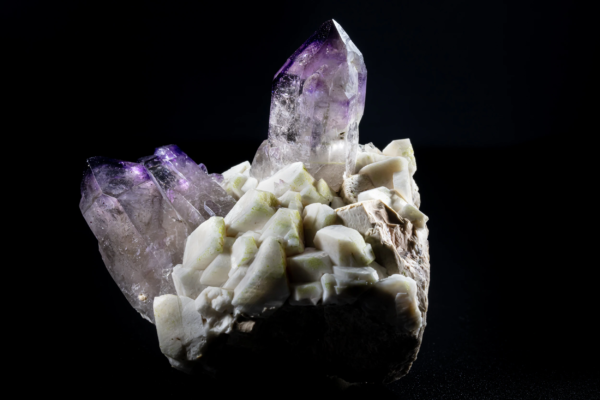
Feldspar is not one mineral but a whole family, and it is the most common mineral group on Earth. Feldspars make up more than half of the planet's crust. The name comes from German, joining the words for field and for a rock that splits cleanly. Miners in Germany kept turning up these pale, cleavable crystals in the fields over their granite. The name has stuck ever since.
Today
Feldspar is everywhere, and it touches daily life more than most people know. It is a key ingredient in pottery, porcelain, and glass, and it gives ceramics their strength. A few feldspars are also gems. Moonstone glows with a soft inner light, amazonite is a cool blue green, and labradorite flashes with bands of blue and gold. For collectors, sharp feldspar crystals are a steady favorite.
Geology & Occurrence
Formation
Feldspar forms as molten rock cools and hardens. It is one of the first minerals to crystallize from magma, so it builds the bulk of granite and many other igneous rocks. It also forms in metamorphic rocks and survives in sandstones. Wherever you find granite, you are looking mostly at feldspar and quartz grown together.
Notable Localities
Feldspar is found across the whole world, since it makes up so much of the crust. Fine crystals come from the granite pegmatites of Brazil, Pakistan, and Madagascar. Gem moonstone comes from Sri Lanka and India, amazonite from Colorado and Russia, and labradorite from Canada and Madagascar. Few minerals are so widespread yet so varied.
The feldspar family splits into two main branches. One branch, rich in potassium and sodium, includes orthoclase and microcline. The other, called plagioclase, runs in a smooth series from sodium rich albite to calcium rich anorthite. The two branches share the same basic build but differ in the metals they carry. Between them, they form the framework of most of the rocks beneath our feet.