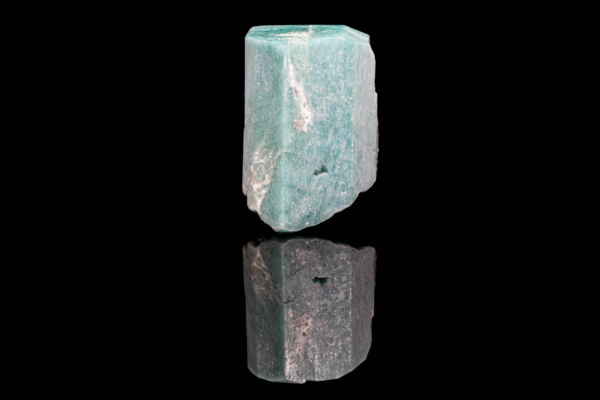
Identity
Technical notes (click to open)(click to close)
Name & Human History
Etymology
Amazonite takes its name from the Amazon River in South America. That name is a bit of a mystery. People linked the green stone to the river long ago. Yet no real amazonite deposit has ever been found in the Amazon basin. The green gems that early traders tied to the region were probably something else. The name stuck anyway, and this blue green feldspar has carried it ever since.
Through the Ages
People have prized amazonite for its calm blue green color since ancient times. The Egyptians cut it into beads, amulets, and inlays thousands of years ago. Carved pieces have been found in their tombs. Polished amazonite has a cool, soothing color a little like turquoise. So it was often used the same way, set into jewelry and ornaments. People believed it could please the eye and protect the wearer.
Today
Today amazonite is a popular and affordable gemstone. It is cut into smooth cabochons, beads, and tumbled stones. Its soft green to blue green color is often crossed by white streaks, so each piece looks a little different. Collectors also seek fine crystals, especially those that grow together with smoky quartz. There the green and the dark brown set each other off. It remains one of the most recognizable of the feldspars.
Geology & Occurrence
Formation
Amazonite is not a mineral of its own but a green variety of microcline, a common potassium feldspar. It forms in coarse grained rocks called pegmatites. These are the same slow cooled veins that produce many large, clean crystals. The white streaks running through most amazonite are thin layers of a second feldspar, albite. They separated out as the crystal cooled. Good crystals often share their pocket with smoky quartz, topaz, and other pegmatite minerals.
Notable Localities
Russia's Ilmen Mountains were the classic old source, supplying rich green crystals for generations. Today some of the finest amazonite comes from Pikes Peak in Colorado. There bright green crystals grow with smoky quartz in granite pockets. Other good material comes from Madagascar, Brazil, Ethiopia, and several more countries, since microcline itself is found almost everywhere.
For a long time, no one could explain amazonite's unusual color. Most green minerals get their color from copper, so people assumed amazonite did too. The real answer came in 1985. Researchers at Caltech showed that the color comes from tiny amounts of lead in the crystal. It works together with traces of water and the slow effect of natural radiation. The green of amazonite is one of the few in the mineral world that has nothing to do with copper.
Some of the world's most beautiful amazonite grows in the granite of Pikes Peak in Colorado. There the green crystals often form locked together with jet black smoky quartz, and the contrast is striking. Both owe their color to the same hidden cause. Natural radiation deep in the rock darkens the quartz and helps bring out the green in the amazonite. Collectors prize these pairings as some of the finest feldspar specimens anywhere.