Identity
Technical notes (click to open)(click to close)
Name & Human History
Etymology
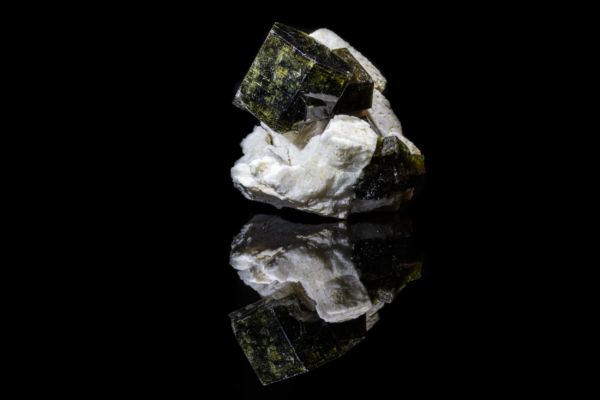
Albite gets its name from the Latin word albus, meaning white, for the plain white color it usually shows. Two Swedish chemists named it in 1815, working from crystals found in Sweden. The name fits a mineral that is easy to overlook. Albite is one of the most common minerals on Earth. It is a quiet white building block, hiding in plain sight inside ordinary rock.
Today
Albite rarely gets attention on its own, but it does steady, useful work. As one of the sodium feldspars, it is mined in bulk and melted into glass and ceramics. There it helps the mix flow and fuse at a lower heat. It also goes into the glaze on tiles and pottery. For collectors, the appeal is different. Clean white tabular crystals are prized for their crisp shape and their role as a backdrop to showier minerals.
Geology & Occurrence
Formation
Albite belongs to the feldspar family, the most common mineral group in the Earth's crust. It sits at the sodium rich end of a long chain of related feldspars. Calcium rich kinds sit at the other end. Albite forms as molten rock cools, so it makes up much of granite and similar stone. It also grows in coarse veins called pegmatites, where slow cooling lets crystals reach a good size. And it turns up in rocks reshaped by heat and pressure deep underground.
Notable Localities
Because albite is so common, fine crystals turn up in many countries. Brazil and Pakistan produce sharp specimens from pegmatites, often beside gem minerals like tourmaline and aquamarine. Switzerland and Italy yield clean alpine crystals. The mineral was first described from Sweden, and good examples still come from across Scandinavia and far beyond.
Look closely at a polished granite countertop. Much of the white and pale gray you see is feldspar like albite. It is one of the main minerals that build the continents themselves. Few people ever notice it. Yet albite and its feldspar relatives make up more of the Earth's crust than any other mineral group. It is the very definition of common, which is exactly what makes it matter.
A few kinds of albite hide a surprise. Sometimes albite and a close relative grow in fine alternating layers. Light bouncing between those layers can give off a soft blue glow, a shimmer much like moonstone. This variety is called peristerite, from the Greek word for pigeon. The name fits, because the sheen recalls the colors on a pigeon's neck. The plain white feldspar, it turns out, can put on a quiet show.