Identity
Technical notes (click to open)(click to close)
Name & Human History
Etymology
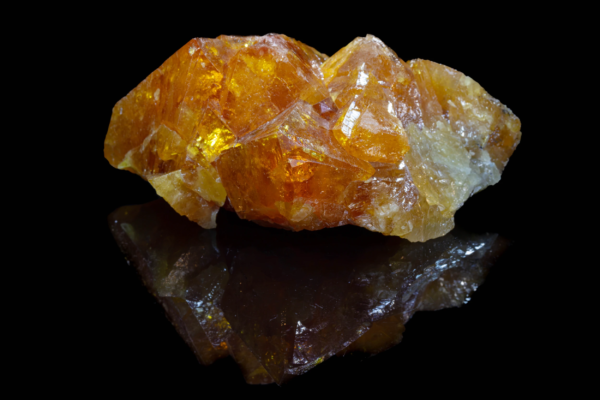
Scheelite is a calcium tungstate, one of the two main ores of tungsten. It forms glassy, honey to orange crystals shaped like blunt double pyramids that can look almost like octahedrons, and it is surprisingly heavy for its size. It was named in 1821 for Carl Wilhelm Scheele, the Swedish chemist whose work on the mineral led to the discovery of the metal tungsten.
Today
Scheelite is both an industrial ore and a collector's favorite. Tungsten, the metal it yields, makes the hardest cutting tools and once made the filaments in light bulbs. For collectors, scheelite is prized for its glowing crystals and, above all, for its brilliant blue white glow under ultraviolet light.
Geology & Occurrence
Formation
Scheelite forms at high temperature, where hot fluids from cooling granite invade nearby rock. Its classic home is the skarn, the altered zone where such fluids bake limestone. It also grows in quartz veins and pegmatites. It forms a series with powellite, a similar mineral in which molybdenum takes the place of tungsten.
Notable Localities
Fine scheelite comes from many lands. Large crystals are found in China, especially at Mount Xuebaoding in Sichuan, and superb specimens have come from the Tae Hwa mine in South Korea. Historic European crystals come from the Alps, from Saxony, and from the Czech Republic, and the mineral is widespread in tungsten districts worldwide.
Scheelite helped find its own ore by glowing in the dark. Under an ultraviolet lamp it flares a vivid blue, and prospectors learned to hunt for tungsten by walking old mine workings at night, lamp in hand, watching for that cold blue light on the walls. Deposits thought worked out were reopened once the glow revealed ore the daylight had missed.