Identity
Technical notes (click to open)(click to close)
Name & Human History
Etymology
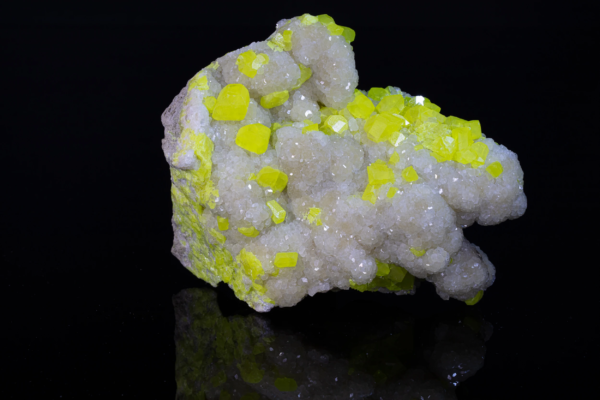
Sulfur is a bright yellow native element, one of the few elements found pure in nature. It is soft and light, with a resinous shine, and its sunny yellow color is unmistakable. It is famous as brimstone, the burning stone of old stories. It catches fire easily and burns with a blue flame and a sharp, choking smell. It often forms glassy yellow crystals around volcanoes.
Through the Ages
Sulfur has been useful and feared for thousands of years. The ancients burned it to fumigate and to drive off pests, and it became a key part of gunpowder. Today it is one of the most important of all industrial materials. It is used above all to make sulfuric acid, the workhorse chemical behind fertilizers and countless other goods.
Geology & Occurrence
Formation
Sulfur forms in two main settings. Around volcanoes and hot springs, it crusts out directly from rising gases as bright yellow coatings and crystals. It also gathers in great underground beds, where bacteria slowly free it from sulfate rocks. These hidden beds, often capping salt domes, hold most of the world's mined sulfur.
Notable Localities
Sulfur comes from volcanoes and salt domes around the world. The old mines of Sicily, in Italy, produced superb yellow crystals, often with white celestine. Fine crystals also come from Poland and Bolivia. The volcanoes of Indonesia glow with sulfur, and great beds lie under the Gulf coast of the United States.
Sulfur asks to be handled with care, for it is both soft and touchy. It scratches easily, and it dislikes warmth. Holding a sulfur crystal in a warm hand can make it crackle and even split, because its surface swells faster than its core. So a fine sulfur specimen is best kept cool, away from heat and bright light.